Legal Disclaimer: This article provides general information about nanny employment topics and is not legal, tax, or financial advice. Laws vary by state and locality. Consult a qualified attorney, CPA, or tax professional for advice specific to your situation.
If you employ a nanny, you are a household employer. That simple fact carries a set of federal and state tax obligations that many parents overlook until they face penalties, back taxes, or an awkward conversation with their accountant every April. The so-called "nanny tax" is not a single tax. It is the collective term for Social Security, Medicare, federal and state unemployment, and income tax withholding that apply when you pay a household employee above certain wage thresholds.
This guide walks through every obligation step by step so you can stay compliant, avoid penalties, and make tax season as painless as possible. Whether you just hired your first nanny or have been paying under the table for years and want to get right with the IRS, start here.
For 2026, you owe nanny taxes if you pay a household employee $3,000 or more in a calendar year. This triggers FICA obligations (Social Security and Medicare). If you pay $1,000 or more in any quarter, you also owe FUTA (federal unemployment tax). Failing to comply can cost you 25% or more in penalties and interest.
What Is the Nanny Tax?
The nanny tax refers to federal employment taxes that household employers must pay when they compensate a domestic worker above the annual threshold set by the IRS. The term covers several distinct taxes:
- Social Security tax: 6.2% from the employer, 6.2% from the employee (12.4% total) on wages up to $184,500 in 2026
- Medicare tax: 1.45% from the employer, 1.45% from the employee (2.9% total), no wage cap
- Federal Unemployment Tax (FUTA): 6.0% on the first $7,000 of wages, reduced to 0.6% with full state credit
- State unemployment tax (SUTA): Varies by state, typically 1% to 5% on a state-defined wage base
- Federal income tax withholding: Optional unless your nanny requests it via Form W-4
- State and local income tax withholding: Required in most states that levy an income tax
The nanny tax applies to nannies, housekeepers, senior caregivers, private cooks, gardeners, and other household workers. It does not apply to independent contractors such as a plumber you call for a one-time repair. Because you control when, where, and how your nanny works, the IRS classifies them as a W-2 employee, not a 1099 contractor.
Is a Nanny a Household Employee? (W-2 vs. 1099)
Yes — a nanny is a household employee in virtually every case, and that single classification drives everything else in this guide. The IRS test is control: if you decide what work is done and how it is done — the schedule, the routine, the house rules, the way care is delivered in your home — the worker is your employee. It does not matter whether the arrangement is part-time, temporary, or found through an agency, and it does not matter what you and the nanny would prefer to call it.
That means a nanny gets a W-2, not a 1099. Issuing a 1099 to a nanny misclassifies an employee as an independent contractor: it illegally shifts your share of FICA onto her, denies her unemployment coverage, and exposes you to back taxes and penalties if it surfaces — commonly when a former nanny files for unemployment benefits. The narrow exceptions to household-employee status are workers who genuinely run their own business (they control their methods, work for many clients, provide their own equipment — think of an agency-employed temp whose W-2 comes from the agency), your spouse, your child under 21, your parent (in most cases), and any employee under age 18 whose principal occupation is being a student.
"Household employee taxes," "nanny taxes," and "domestic employer taxes" all describe the same obligation set covered in the steps below: FICA, unemployment taxes, and any state-level programs your state adds on top.
Do You Owe Nanny Taxes? The 2026 Thresholds
Not every babysitting arrangement triggers tax obligations. The IRS uses two thresholds to determine when household employer taxes kick in:
| Tax Type | 2026 Threshold | What It Triggers |
|---|---|---|
| FICA (Social Security & Medicare) | $3,000 in cash wages per year | Both employer and employee shares of Social Security and Medicare |
| FUTA (Federal Unemployment) | $1,000 in any calendar quarter | Federal unemployment tax (employer-only) |
If you pay your nanny $3,000 or more during the calendar year, you must withhold and pay FICA. If you pay $1,000 or more in any single quarter, you owe FUTA. Most full-time nanny arrangements exceed both thresholds within the first month or two of employment.
Exception: If your household employee is your spouse, your child under age 21, or your parent (with specific conditions), different rules apply. Casual babysitters under age 18 whose primary occupation is not household work are also exempt.
Step 1: Get Your Employer Identification Number (EIN)
Before you can report or pay any employment taxes, you need a federal Employer Identification Number. This is separate from your Social Security number and is used exclusively for employer tax filings.
- Go to IRS.gov and search for the EIN application
- Complete the online application (available Monday through Friday, 7 a.m. to 10 p.m. Eastern)
- Select "Household Employer" as the type of entity
- Receive your EIN immediately upon completion
You will also need to register as an employer with your state tax agency and your state's unemployment insurance program. Most states require a separate state employer ID number. Some states, like California, also require registration with the Employment Development Department (EDD) within 15 days of paying $750 or more in wages in a quarter.
Step 2: Verify Your Nanny's Work Eligibility
Federal law requires you to verify that your nanny is legally authorized to work in the United States. Have your nanny complete Form I-9 (Employment Eligibility Verification) on or before their first day of work. You must examine the original identity and work authorization documents your nanny presents. Keep the completed I-9 on file for at least three years after the hire date or one year after employment ends, whichever is later.
You also need your nanny's Social Security number for tax reporting purposes. If your nanny does not have one, they should apply at their local Social Security Administration office.
Step 3: Determine Wages and Withholding
Once you have hired your nanny and established a written employment agreement, you need to set up proper withholding. Here is what to collect and calculate:
Form W-4
Have your nanny complete IRS Form W-4 if they want federal income tax withheld from each paycheck. Federal income tax withholding is technically optional for household employers, but most nannies prefer it because it prevents a large tax bill in April. Use the IRS withholding tables or the IRS Tax Withholding Estimator to calculate the correct amount.
FICA Calculations
For each pay period, calculate:
- Employee share: 7.65% (6.2% Social Security + 1.45% Medicare)
- Employer share: 7.65% (same breakdown)
You can either withhold the employee's 7.65% from each paycheck or choose to absorb their share yourself. If you pay the employee's share, that amount becomes additional taxable income to your nanny.
Sample Paycheck Calculation
Suppose your nanny earns $1,000 per week gross. Here is how a single paycheck breaks down:
| Item | Amount |
|---|---|
| Gross pay | $1,000.00 |
| Social Security (employee 6.2%) | -$62.00 |
| Medicare (employee 1.45%) | -$14.50 |
| Federal income tax (estimated) | -$85.00 |
| State income tax (varies) | -$40.00 |
| Net pay | $798.50 |
On top of this, you as the employer owe an additional $76.50 in FICA (your matching 6.2% + 1.45%) plus FUTA and SUTA. Understanding the full cost of employing a nanny helps you budget accurately from the start.
Step 4: Set Up Payroll
Running nanny payroll means establishing a consistent schedule for paying your nanny, calculating withholding, and keeping records. You have three options:
- DIY payroll: Calculate taxes manually each pay period, issue checks, and handle all filings yourself. This works if you are comfortable with tax math and deadlines, but mistakes are common.
- Payroll software: Poppins Payroll automates calculations, generates pay stubs, handles tax filings, and produces W-2s — all tailored for household employers — for $49 per month. Beverly members who are new Poppins clients get a full year included in their membership.
- Full-service payroll + platform: Beverly integrates payroll guidance into the hiring process so you start compliant from day one.
Regardless of which method you choose, maintain detailed records of every payment, including dates, gross wages, deductions, and net pay. Keep these records for at least four years, as required by the IRS.
Step 5: Pay Taxes Quarterly (or Adjust Withholding)
Household employers do not file a separate quarterly payroll return like a business would. Instead, you have two options for staying current with the IRS throughout the year:
Option A: Estimated Tax Payments
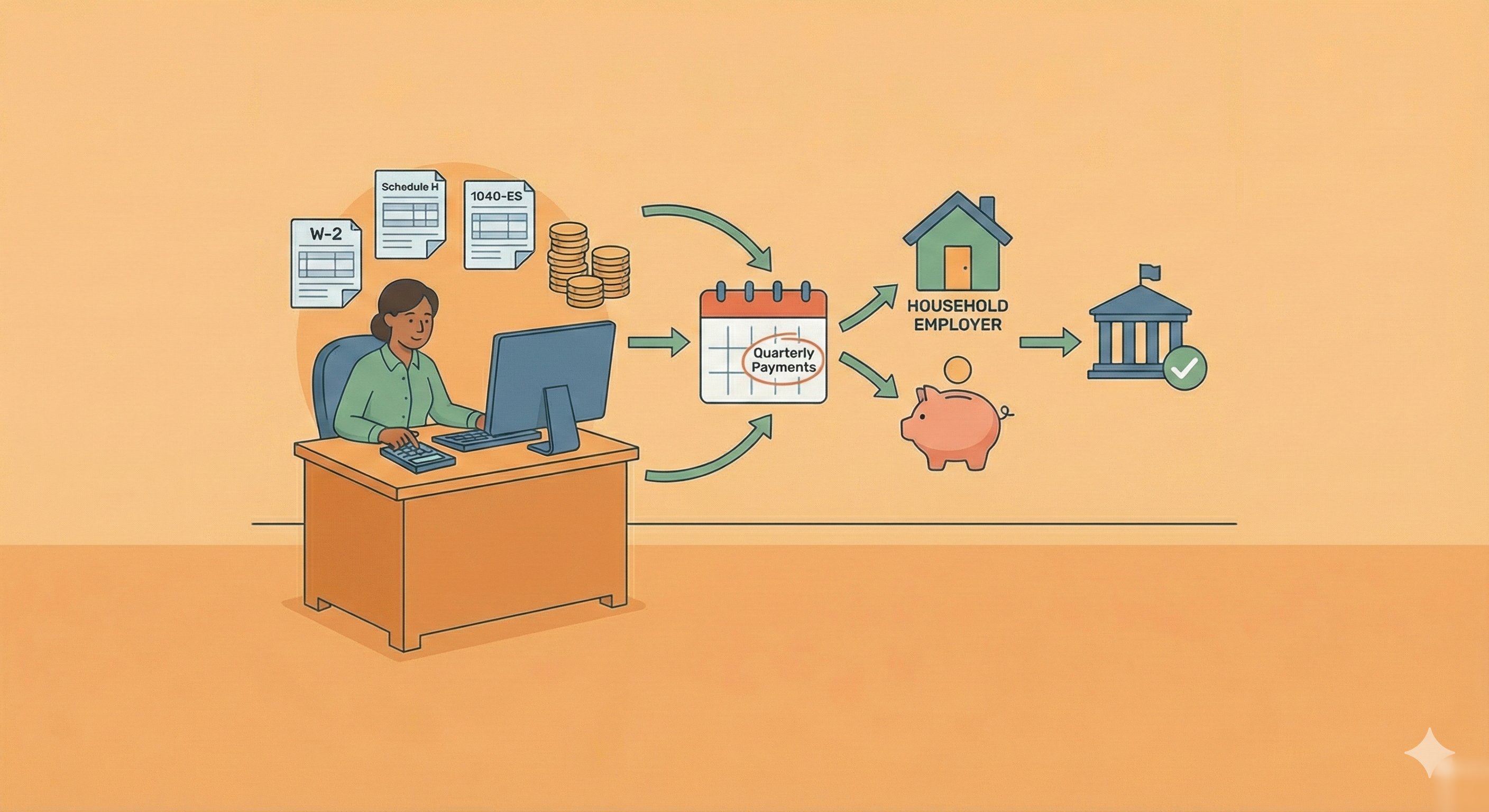
Make quarterly estimated tax payments using Form 1040-ES. This is the most common approach. The deadlines for 2026 are:
| Quarter | Period Covered | Payment Due |
|---|---|---|
| Q1 | January 1 - March 31 | April 15, 2026 |
| Q2 | April 1 - June 30 | June 15, 2026 |
| Q3 | July 1 - September 30 | September 15, 2026 |
| Q4 | October 1 - December 31 | January 15, 2027 |
Option B: Increase Your Own W-4 Withholding
If you work for an employer, you can increase the federal income tax withheld from your own paycheck by filing a new W-4 with your employer. This lets you cover your nanny tax liability without making separate quarterly payments. Many parents find this simpler.
Step 6: Understand FUTA and State Unemployment
The Federal Unemployment Tax Act (FUTA) funds the federal portion of the unemployment insurance system. As a household employer, you owe FUTA at 6.0% on the first $7,000 in wages you pay your nanny each year. However, you receive a credit of up to 5.4% for state unemployment taxes you pay, bringing the effective FUTA rate down to 0.6%.
This means your maximum FUTA liability per employee is typically $42 per year ($7,000 x 0.6%).
State Unemployment (SUTA) Requirements
Every state runs its own unemployment insurance program with different rates and wage bases. Here are the household employer thresholds for key states:
| State | Registration Threshold | Typical New Employer Rate |
|---|---|---|
| California | $750 in a quarter | 3.4% |
| New York | $500 in a quarter | 4.1% |
| Texas | $1,000 in a quarter | 2.7% |
| Illinois | $1,000 in a quarter | 3.65% |
| Florida | $1,000 in a quarter | 2.7% |
| Washington | $1,000 in a quarter | Varies (experience rating) |
| Massachusetts | $1,000 in a quarter | 1.87% |
| Georgia | $1,000 in a quarter | 2.7% |
| Washington, D.C. | $500 in a quarter | 2.7% |
Some states, including New York and California, also require household employers to carry workers' compensation insurance.
See what a coordinated search looks like. The research is the easy part. In two minutes, watch how a Beverly coordinator runs the rest — agencies, screening, and contracts — so you don't have to.
Watch: Meet Beverly · 2 min →Step 7: Handle Overtime Correctly
Nannies are generally non-exempt employees under the Fair Labor Standards Act (FLSA), which means they are entitled to overtime pay at 1.5 times their regular hourly rate for hours worked beyond 40 in a workweek. Some states have additional overtime requirements that go beyond federal law.
For example, California requires overtime after 9 hours in a single day for domestic workers, not just after 40 hours in a week. New York requires overtime after 44 hours for live-in domestic workers. Make sure your payroll calculations account for the applicable overtime rules in your state.
Step 8: File Schedule H with Your Tax Return
At the end of the year, you report all household employment taxes on IRS Schedule H (Household Employment Taxes), which you attach to your personal Form 1040. Schedule H calculates your total liability for:
- Social Security and Medicare taxes (both employer and employee shares)
- Federal income tax withheld (if applicable)
- FUTA tax
- Any additional Medicare tax
The total from Schedule H flows to your Form 1040 and increases your tax liability (or reduces your refund). If you have been making quarterly estimated payments or increasing your W-4 withholding throughout the year, most or all of this should already be covered.
Step 9: Issue Form W-2 to Your Nanny
By January 31 of the following year, you must provide your nanny with a completed Form W-2 showing their total wages and all taxes withheld during the prior calendar year. You must also file Copy A of the W-2 with the Social Security Administration (SSA) by January 31.
The W-2 should report:
- Box 1: Total cash wages paid
- Box 2: Federal income tax withheld
- Box 3: Social Security wages
- Box 4: Social Security tax withheld (employee share)
- Box 5: Medicare wages
- Box 6: Medicare tax withheld (employee share)
- Boxes 15-17: State employer ID, state wages, and state income tax withheld
You can file W-2s electronically through the SSA's Business Services Online portal or use a payroll service that handles it for you. Do not use Form 1099-NEC for your nanny. That form is for independent contractors, and your nanny is a W-2 employee.
Step 10: Claim Your Tax Breaks
The silver lining of nanny tax compliance is access to meaningful tax benefits:
Child and Dependent Care Tax Credit
You can claim a credit of 20% to 50% of qualifying child care expenses, up to $3,000 for one child or $6,000 for two or more children. The credit percentage depends on your adjusted gross income.
Dependent Care FSA
If your employer offers a Dependent Care Flexible Spending Account, you can set aside up to $7,500 pre-tax per year ($3,750 if married filing separately) to cover child care costs. This saves you money on both income tax and FICA tax, and the savings can be substantial — potentially $1,500 to $2,000 or more depending on your tax bracket.
Combining the Dependent Care FSA with the Child and Dependent Care Credit is subject to coordination rules. You can only claim the credit on expenses above what you contributed to the FSA, up to the applicable limits. Consult a tax professional to maximize your benefit.
Common Nanny Tax Mistakes and Penalties
The IRS takes household employment taxes seriously. Here are the most common mistakes parents make and the penalties they trigger:
Mistake 1: Paying Under the Table
This is the biggest and most expensive mistake. If the IRS discovers you paid your nanny off the books, you owe all back taxes (both employer and employee shares), plus penalties of up to 25% and interest that compounds daily. In severe cases, willful evasion can result in criminal charges.
Mistake 2: Classifying Your Nanny as a 1099 Contractor
The IRS uses a behavioral control, financial control, and relationship test to determine worker classification. A nanny who works in your home, on your schedule, caring for your children is an employee. Misclassification penalties include 100% of the uncollected employee FICA taxes plus the employer share, plus additional fines.
Mistake 3: Missing Filing Deadlines
Late W-2 filing penalties range from $60 per form (1 to 30 days late) to $130 (filed by August 1) and $340 per form after August 1 — and $680 per form, with no cap, for intentional disregard. Late Schedule H filing triggers the standard failure-to-file penalty of 5% of unpaid taxes per month, up to 25%.
Mistake 4: Forgetting State Requirements
Many parents handle federal taxes but overlook state obligations. Depending on your state, you may owe state income tax withholding, state unemployment insurance, disability insurance (CA, NJ, NY, RI, HI), paid family leave contributions (CA, NJ, NY, MA, WA, CT, OR, CO, MD, DC, MN), and workers' compensation insurance.
Mistake 5: Not Keeping Records
The IRS requires you to keep household employment tax records for at least four years. Without proper records, you cannot defend yourself in an audit. Maintain copies of every paycheck, all tax forms (W-4, I-9, W-2, Schedule H), and your EIN confirmation.
State-by-State Tax Considerations
Beyond federal requirements, your state adds its own layer of employer obligations. Below: detailed summaries for the states where Beverly families most often hire, followed by a hub table covering all 50 states.
California
California requires household employers to withhold State Disability Insurance (SDI) at 1.3% of wages, pay into the Employment Training Tax (ETT) at 0.1%, and register with the EDD. California also mandates paid sick leave (at least 40 hours per year) and workers' compensation insurance for all household employees. Full detail, including SDI rates and EDD registration steps, in our California nanny tax guide.
New York
New York requires workers' compensation and disability insurance for household employees who work 40 or more hours per week. The state also mandates Paid Family Leave contributions. Employers must register with the New York Department of Labor for unemployment insurance. Full detail, including PFL rates and the Domestic Workers' Bill of Rights, in our New York nanny tax guide.
Texas
Texas has no state income tax, so there is nothing to withhold beyond FICA. However, Texas employers still owe SUTA and must register with the Texas Workforce Commission. Workers' compensation is not mandatory in Texas but is recommended. Full detail, including TWC registration, in our Texas nanny tax guide.
Illinois
Illinois requires state income tax withholding and registration with the Illinois Department of Employment Security (IDES) for unemployment insurance. Workers' compensation insurance is required for household employees. Full detail, including Chicago's local ordinances, in our Illinois nanny tax guide.
Washington
Washington has no state income tax but requires Paid Family and Medical Leave contributions (shared between employer and employee) and registration for unemployment insurance. Workers' compensation is not required for a typical single household employee (it becomes mandatory only with two or more domestic employees each regularly working 40+ hours per week), though elective L&I coverage is available and often worth carrying.
Massachusetts
Massachusetts requires state income tax withholding and mandates Paid Family and Medical Leave contributions. Workers' compensation insurance is mandatory for all household employees.
Nanny Taxes in All 50 States: The Hub Table
Every state requires household employers to carry state unemployment insurance once you cross its wage threshold — that obligation is universal. The columns that actually differ are income tax withholding and the state-specific programs stacked on top. Use this table for orientation, then confirm current rates with your state agency or payroll service; for California, New York, Texas, and Illinois we maintain full dedicated guides.
| State | State income tax withholding | What household employers should know (2026) |
|---|---|---|
| Alabama | Yes | Register with the state workforce agency for unemployment insurance |
| Alaska | No | Register with the state workforce agency for unemployment insurance |
| Arizona | Yes | Earned paid sick time accrues for household employees (Prop 206); UI registration at $1,000+/quarter |
| Arkansas | Yes | Register with the state workforce agency for unemployment insurance |
| California | Yes | SDI withholding, EDD registration, 40+ hrs/yr paid sick leave, workers’ comp for essentially every regular nanny — see the California guide |
| Colorado | Yes | FAMLI paid-leave contributions and Healthy Families sick leave apply; Denver sets a higher local minimum wage |
| Connecticut | Yes | CT Paid Leave contributions apply to household employers |
| Delaware | Yes | Register with the state workforce agency for unemployment insurance |
| District of Columbia | Yes | DC Paid Family Leave employer contribution applies |
| Florida | No | Register for reemployment tax (Form RT-6); no income tax to withhold |
| Georgia | Yes | Flat 4.99% income tax for 2026 (cut retroactively by HB 463) |
| Hawaii | Yes | Temporary Disability Insurance (TDI) required for eligible household employees |
| Idaho | Yes | Register with the state workforce agency for unemployment insurance |
| Illinois | Yes | IDES registration, withholding, workers’ comp required — see the Illinois guide |
| Indiana | Yes | County income taxes may also apply |
| Iowa | Yes | Register with the state workforce agency for unemployment insurance |
| Kansas | Yes | Register with the state workforce agency for unemployment insurance |
| Kentucky | Yes | Local occupational taxes may also apply |
| Louisiana | Yes | Register with the state workforce agency for unemployment insurance |
| Maine | Yes | Paid Family and Medical Leave contributions began 2025 |
| Maryland | Yes | Local county income taxes also withheld |
| Massachusetts | Yes | PFML contributions; workers’ comp mandatory at 16+ hrs/week |
| Michigan | Yes | Earned Sick Time Act applies to household employers |
| Minnesota | Yes | Earned Sick and Safe Time accrual; state Paid Leave program contributions |
| Mississippi | Yes | Register with the state workforce agency for unemployment insurance |
| Missouri | Yes | Register with the state workforce agency for unemployment insurance |
| Montana | Yes | Register with the state workforce agency for unemployment insurance |
| Nebraska | Yes | Register with the state workforce agency for unemployment insurance |
| Nevada | No | No income tax; UI (Modified Business Tax rules differ for households — confirm with DETR) |
| New Hampshire | No | No tax on wages |
| New Jersey | Yes | Family Leave Insurance and Temporary Disability contributions apply |
| New Mexico | Yes | Register with the state workforce agency for unemployment insurance |
| New York | Yes | UI, Paid Family Leave, disability insurance, workers’ comp at 40+ hrs/wk, Domestic Workers’ Bill of Rights — see the New York guide |
| North Carolina | Yes | Register with the state workforce agency for unemployment insurance |
| North Dakota | Yes | Register with the state workforce agency for unemployment insurance |
| Ohio | Yes | Municipal income taxes are common and also withheld |
| Oklahoma | Yes | Register with the state workforce agency for unemployment insurance |
| Oregon | Yes | Paid Leave Oregon contributions apply; Portland-area local taxes possible |
| Pennsylvania | Yes | Flat 3.07% withholding; workers’ comp elective for domestic employees; Philadelphia adds wage tax and a Domestic Workers’ Bill of Rights |
| Rhode Island | Yes | TDI withholding applies |
| South Carolina | Yes | Register with the state workforce agency for unemployment insurance |
| South Dakota | No | Register with the state workforce agency for unemployment insurance |
| Tennessee | No | No tax on wages |
| Texas | No | No income tax; TWC unemployment tax (0.32–6.32% on first $9,000 in 2026) — see the Texas guide |
| Utah | Yes | Register with the state workforce agency for unemployment insurance |
| Vermont | Yes | Child Care Contribution payroll tax applies (0.44% employer) |
| Virginia | Yes | Register with the state workforce agency for unemployment insurance |
| Washington | No | No income tax; PFML and WA Cares contributions; workers’ comp elective for a single household employee; Seattle’s Domestic Workers Ordinance adds city rules |
| West Virginia | Yes | Register with the state workforce agency for unemployment insurance |
| Wisconsin | Yes | Register with the state workforce agency for unemployment insurance |
| Wyoming | No | Register with the state workforce agency for unemployment insurance |
Annual Nanny Tax Calendar
Stay on top of every deadline with this annual calendar:
| Date | Action Required |
|---|---|
| January 31 | Give W-2 to your nanny; file Copy A with SSA |
| April 15 | File personal tax return with Schedule H; Q1 estimated payment |
| June 15 | Q2 estimated tax payment |
| September 15 | Q3 estimated tax payment |
| January 15 (next year) | Q4 estimated tax payment |
| Ongoing | State quarterly unemployment filings (varies by state) |
| Ongoing | Each pay period: calculate and withhold taxes, issue pay stubs |
How to Get Compliant If You Have Been Paying Under the Table
If you have been paying your nanny without withholding taxes, it is not too late to get on the right side of the law. Here is a practical path forward:
- Apply for your EIN and register with your state immediately.
- Start withholding from the next paycheck. Going forward, deduct the employee's FICA share and any agreed-upon income tax withholding.
- File amended returns if you missed prior years. Work with a CPA or tax professional to determine the best approach. The IRS is generally more lenient with voluntary disclosure than with taxpayers caught in an audit.
- Catch up on state filings. Register with your state unemployment agency and make any required back payments.
- Put systems in place. Set up a payroll service or use a platform like Beverly to prevent future compliance gaps.
The IRS has a voluntary classification settlement program and may reduce penalties for employers who come forward proactively. A tax professional experienced in household employment can guide you through the process efficiently.
Do You Need a Payroll Service?
You are not legally required to use a payroll service, but the time, complexity, and risk of manual nanny tax compliance make it worth considering. Poppins Payroll costs $49 per month and handles:
- Tax calculations for every paycheck
- Direct deposit or check processing
- Federal and state tax deposits
- Schedule H preparation
- W-2 generation and filing
- State unemployment filings
- Year-end tax documents
Poppins Payroll handles all of these tasks for household employers — from automated tax calculations to year-end W-2 filing — for $49 per month, so you stay compliant without becoming a payroll expert. Beverly members who are new Poppins clients get a full year included in their membership.
If you are managing a single nanny on a straightforward schedule, DIY payroll is feasible. But if you have variable hours, overtime situations, or employees in states with complex requirements (California, New York, Massachusetts), a payroll service pays for itself in avoided mistakes.
Legal Disclaimer: This article provides general information about nanny employment topics and is not legal, tax, or financial advice. Laws vary by state and locality. Consult a qualified attorney, CPA, or tax professional for advice specific to your situation.
FAQ

See how Beverly actually works
Your family's hiring coordinator — one point of contact working top agencies, au pair programs, and your personal network, all at once.
Captions on — no sound needed.Even though we work to keep the information, stats, and details in this article accurate and up to date, please do your own financial and legal due diligence before acting on anything you read here, and reach out directly to the private companies and government agencies referenced for the most current details.