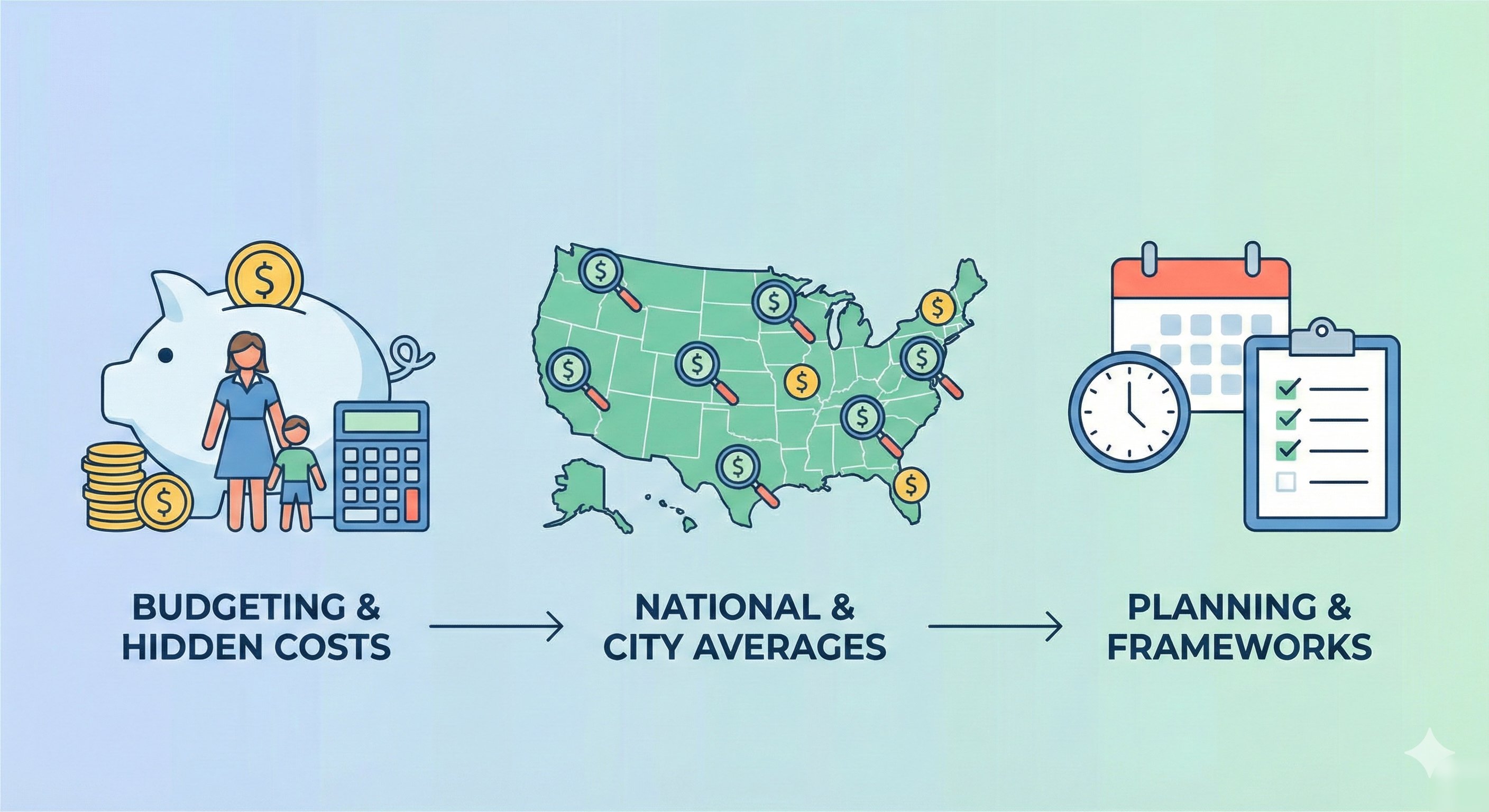
You have just returned from a 14-hour day at the hospital, the office, or the courtroom, and the math is running in the back of your mind: how much does a nanny cost, and can we actually afford one? The answer is more nuanced than a single number, because nanny pricing is shaped by your city, the type of care you need, your nanny's experience, and a handful of hidden costs that most families discover only after they have already made an offer.
This guide breaks down every variable that determines what you will pay for a nanny in 2026. We will cover national averages, city-by-city rate comparisons, cost differences by nanny type, the true total cost of employment (including taxes and benefits), and practical budgeting strategies that families at every income level can use to make high-quality childcare work.
The national average nanny rate in 2026 is $20-25 per hour for one child, translating to roughly $41,600-$52,000 per year for full-time care. Add 15-25% for employer taxes, benefits, and insurance. Your actual cost depends heavily on your metro area, the number of children, and whether you need specialized care like infant expertise or overnight coverage.
National Average Nanny Costs in 2026
Before we drill into specific cities, here is the big picture. Nanny rates have increased roughly 8-12% over the past three years, driven by inflation, a tighter labor market for experienced caregivers, and rising minimum wages in major metro areas. The days of finding a qualified, experienced nanny for $15 per hour in a major city are over in most parts of the country.
| Care Scenario | Hourly Rate Range | Weekly (40 hrs) | Annual Estimate |
|---|---|---|---|
| One child, moderate COL area | $18-22/hr | $720-880 | $37,440-$45,760 |
| One child, high COL area | $25-32/hr | $1,000-1,280 | $52,000-$66,560 |
| Two children, moderate COL | $20-26/hr | $800-1,040 | $41,600-$54,080 |
| Two children, high COL | $28-36/hr | $1,120-1,440 | $58,240-$74,880 |
| Three+ children | $25-40/hr | $1,000-1,600 | $52,000-$83,200 |
These figures represent gross wages only. Your total out-of-pocket cost will be higher once you account for employer-side taxes and any benefits you provide. We cover that math in detail below.
How Much Does a Nanny Cost by City?
Geography is the single largest variable in nanny pricing. A nanny in San Francisco commands nearly double the hourly rate of one in Dallas, not because she is twice as good, but because the cost of living index in San Francisco is 93% higher. Here is how the top metro areas compare.
| City | Hourly Range | COL Index | State Min Wage | Detailed Guide |
|---|---|---|---|---|
| San Francisco | $30-50/hr | 195 | $16.90 | SF Pricing Guide |
| New York City | $28-45/hr | 187 | $17.00 | NYC Pricing Guide |
| Seattle | $24-42/hr | 168 | $17.13 | Seattle Pricing Guide |
| Los Angeles | $25-42/hr | 166 | $16.90 | LA Pricing Guide |
| Washington DC | $25-42/hr | 152 | $17.95 | DC Pricing Guide |
| San Diego | $22-38/hr | 128 | $16.90 | SoCal Pricing Guide |
| Miami | $22-38/hr | 118 | $14.00 | Miami Pricing Guide |
| Chicago | $22-38/hr | 107 | $15.00 | Chicago Pricing Guide |
| Atlanta | $20-35/hr | 107 | $7.25 | Atlanta Pricing Guide |
| Austin | $20-35/hr | 105 | $7.25 | Austin Pricing Guide |
| Dallas | $20-35/hr | 101 | $7.25 | Dallas Pricing Guide |
| Phoenix | $18-32/hr | 97 | $15.15 | Pricing Guide |
A useful rule of thumb: for every 10 points above 100 on the cost-of-living index, expect to add roughly $1.50-2.00 per hour to a baseline national rate of $18/hr. This is not precise, but it helps you calibrate expectations quickly when comparing markets.
Nanny Costs by Type of Care
Not all nanny arrangements are structured the same way, and the type of care you need has a significant impact on what you will pay. Here is how the major categories compare.
Full-Time Nanny (40-50 hours/week)
The most common arrangement. A full-time nanny typically works 8-10 hours per day, five days per week. Expect to pay the standard market rate for your city. Full-time nannies generally expect a benefits package that includes paid time off (typically 10-15 days per year), guaranteed hours (meaning you pay them even when you don't need them, such as during your vacation), and at least partial health insurance coverage. These benefits add 10-15% to your base labor cost.
Part-Time Nanny (Under 30 hours/week)
Part-time nannies often charge $1-3 more per hour than full-time nannies in the same market. This premium exists because part-time work limits their ability to take another full-time position. A part-time nanny working 20 hours per week at $2 more per hour may seem cheaper overall, but the hourly cost of care is actually higher. If your schedule truly requires only part-time care, a nanny share (splitting a nanny with another family) can offer better value.
Live-In Nanny
A live-in nanny resides in your home, typically in a private bedroom or suite. Hourly rates for live-in nannies are $2-5 lower than live-out nannies because room and board is considered part of their compensation. However, you need to provide a private room, meals, and often a car or transit pass. When you add these costs, the total expense is often comparable to a live-out arrangement. Live-in nannies are most cost-effective when you have a separate guest suite and need extended or irregular hours.
Night Nanny or Newborn Care Specialist
A night nanny works overnight (typically 8pm-6am) to handle feedings, diaper changes, and sleep training for newborns. Rates are $25-40 per hour in most markets, with a premium for certified newborn care specialists. Most families use a night nanny for 8-16 weeks after birth. The total investment of $8,000-$20,000 is significant, but families consistently report it is the single highest-value childcare expenditure they make, particularly for parents returning to demanding careers.
Nanny Share
In a nanny share, two families split one nanny. Each family typically pays 60-70% of the full rate rather than 50%, because the nanny is managing more children. For example, if a full-time nanny in your market costs $25/hr, each family in a share might pay $16.50-$17.50/hr. The nanny earns $33-35/hr total (about 1.3-1.4x her solo rate), which is a significant raise, while each family saves 30-40% compared to hiring their own nanny. Shares work best with children of similar ages and families with compatible schedules and parenting styles.
The 8 Factors That Determine Your Nanny's Rate
When you see a nanny rate quoted online, the number you actually pay will depend on these eight variables. Understanding them helps you negotiate effectively and set realistic expectations.
1. Geographic Location
As shown in the city comparison above, this is the largest single factor. A nanny in San Francisco can command $25-35/hr while a nanny with identical qualifications in Dallas might earn $16-23/hr. The difference is driven almost entirely by local cost of living and the minimum wage floor in each market.
2. Number and Ages of Children
The standard premium for a second child is $2-4 per hour. A third child adds another $2-3/hr. Infants under 12 months command higher rates than toddlers or school-age children because infant care is more labor-intensive and carries greater responsibility. A nanny caring for twins under one in a high-cost city might earn $35-45/hr.
3. Experience and Qualifications
A nanny with 1-3 years of experience is at the low end of your market's range. A nanny with 7-10+ years of experience, early childhood education credentials, or specialized training (such as RIE certification, sleep training expertise, or special needs experience) commands the top of the range or beyond it. The premium for experience is justified: seasoned nannies require less oversight, handle emergencies with confidence, and build developmental activities into the day without being asked.
4. Hours and Schedule
Standard hours (roughly 7am-6pm, Monday through Friday) get standard rates. Early mornings, evenings, weekends, and overnight hours command a 15-25% premium. Split shifts (e.g., 7-9am and 3-7pm) may also carry a premium because they prevent the nanny from taking other work during the gap. Any hours beyond 40 per week must be paid at 1.5x the regular rate per federal overtime law.
5. Job Responsibilities
A nanny who provides childcare only will cost less than one expected to handle household management, cooking, laundry, errands, tutoring, or driving children to multiple activities. Each additional responsibility adds complexity and value. Be specific about expectations in your job description, because scope creep without corresponding pay increases is the top reason nannies leave positions.
6. Benefits Package
The market has shifted. In 2026, competitive benefits packages for full-time nannies typically include 2 weeks paid vacation, 5-7 paid sick days, 5-6 paid holidays, guaranteed hours, and either a health insurance stipend ($200-400/month) or enrollment in your employer plan. Families who offer strong benefits can often negotiate hourly rates 5-10% below market because nannies value stability and coverage.
7. Contract Terms and Guaranteed Hours
Guaranteed hours mean you pay your nanny for a set number of hours per week even if you do not need her. If you take a two-week vacation, you still pay her. This is standard practice in professional nanny employment and protects your nanny from income instability. It also protects you: without guaranteed hours, your nanny may seek other work during your absences and eventually leave for a more reliable position.
8. How You Found Your Nanny
Agency-placed nannies tend to have higher rates because agencies vet candidates thoroughly and match families with specific needs. Agency placement fees range from $2,000-8,000 (or 10-15% of annual salary). Nannies found through online platforms or referrals may offer lower rates, but you invest more of your own time in vetting and onboarding. Services like Beverly coordinate across multiple channels so you're not limited to one pipeline.
The True Total Cost: Taxes, Insurance, and Benefits
The hourly rate is only part of the picture. As a household employer, you have legal and practical obligations that add 15-25% to your gross labor cost. Here is the full breakdown.
Employer Taxes
If you pay a household employee more than $3,000 in a calendar year (the 2026 threshold), you must pay employer-side taxes. For a detailed walkthrough of these obligations, see our nanny tax guide.
- Social Security (employer share): 6.2% of gross wages
- Medicare (employer share): 1.45% of gross wages
- Federal Unemployment Tax (FUTA): 0.6% on the first $7,000 of wages
- State Unemployment Tax (SUTA): varies by state, typically 2-5% on the first $7,000-$40,000 of wages
Total employer tax burden: approximately 9-12% of gross wages. On a $50,000 annual salary, that is $4,500-$6,000 in additional cost.
Workers' Compensation Insurance
Required in most states and strongly recommended everywhere. Workers' comp protects you from personal liability if your nanny is injured on the job. Cost: typically $200-600 per year, depending on your state and the nanny's wage level.
Payroll Service
While not legally required, a payroll service handles tax withholding, filings, and year-end W-2 preparation. Poppins Payroll specializes in household employment for $49 per month. Most accountants and tax advisors strongly recommend using a dedicated nanny payroll service, because the penalties for mishandling household employment taxes can be severe. Beverly members who are new Poppins clients get a full year of Poppins Payroll included in their membership.
Total Cost Model
Here is what a full-time nanny actually costs, using a moderate-cost-of-living city as an example.
| Cost Component | Annual Amount |
|---|---|
| Gross wages ($22/hr x 40 hrs x 52 weeks) | $45,760 |
| Employer Social Security + Medicare (7.65%) | $3,501 |
| FUTA + SUTA (estimated) | $500 |
| Workers' compensation insurance | $400 |
| Payroll service ($60/mo) | $720 |
| Paid time off (3 weeks at $880/week) | $2,640 |
| Health insurance stipend ($300/mo) | $3,600 |
| Total Annual Cost | $57,121 |
That $22/hr nanny actually costs about $27.46/hr when you account for everything. This 25% premium is why financial planning matters so much when hiring a nanny.
Nanny vs. Daycare: The Real Cost Comparison
Families frequently ask whether a nanny or daycare is more cost-effective. The answer depends on how many children you have and what you value beyond the bottom line.
| Factor | Nanny | Daycare Center |
|---|---|---|
| Monthly cost (1 child) | $2,880-$4,480 | $1,200-$2,400 |
| Monthly cost (2 children) | $3,200-$5,200 | $2,400-$4,800 |
| Monthly cost (3 children) | $3,600-$5,600 | $3,600-$7,200 |
| Schedule flexibility | High | Low |
| Sick child coverage | Yes | No (child sent home) |
| Commute time for parents | None | 15-40 min round trip |
| Germ exposure | Lower | Higher |
| Individualized attention | 1:1 or 1:2 | 1:4 to 1:8 |
The crossover point is typically two children. With two kids, a nanny becomes competitive with or cheaper than two daycare spots, especially in high-cost markets. With three children, a nanny is almost always more economical. For families with demanding or unpredictable work schedules, the value of a nanny's flexibility often outweighs the cost premium even for one child.
How to Budget for a Nanny: A 5-Step Framework
Budgeting for a nanny is fundamentally different from budgeting for daycare. With daycare, you get a monthly bill. With a nanny, you are running a one-employee business. Here is how to plan for it.
Step 1: Calculate Your Maximum Monthly Childcare Budget
Start with your household take-home income. Most financial advisors suggest childcare should not exceed 20-25% of net income, though in high-cost cities, many dual-income professional families spend 30% or more. Be honest about what is sustainable over 3-5 years, not just the first six months when motivation is highest.
Step 2: Research Your Local Market Rate
Use the city guides linked above or check your specific metro area. Talk to other parents in your neighborhood, not just online forums. Local parent networks at your pediatrician's office, your workplace, or your child's future school are the most reliable source of current rate information.
Step 3: Add the Employer Cost Layer
Take your expected gross hourly rate, multiply by 40 (or your expected weekly hours), multiply by 52, and then add 20-25% for taxes, insurance, and benefits. This is your projected total annual cost. Divide by 12 for your monthly number.
Step 4: Identify Tax Benefits That Reduce Your Net Cost
Two significant tax benefits can reduce your nanny cost by $3,000-$5,000 per year:
- Dependent Care FSA: Set aside up to $7,500 pre-tax per household to pay for childcare. At a combined marginal tax rate of 35%, this saves roughly $2,600.
- Child and Dependent Care Tax Credit: Worth up to $1,500 for one child or $3,000 for two children under the 2026 rules, depending on your income — most higher-income families qualify for the 20% rate, which works out to $600 for one child or $1,200 for two. Note that you cannot double-dip: expenses used for the FSA cannot also be used for the credit.
These benefits are only available if you pay your nanny on the books. Paying legally is the right thing to do, and it is the financially smart thing to do.
Step 5: Build a Contingency Buffer
Set aside 5-10% of your annual nanny budget as a contingency. This covers overtime during busy work periods, backup care when your nanny is sick, potential rate increases at your nanny's annual review, and any gaps in coverage if your nanny leaves and you need to hire a replacement. An emergency childcare fund of $2,000-$5,000 prevents scrambling when the unexpected happens.
See what a coordinated search looks like. The research is the easy part. In two minutes, watch how a Beverly coordinator runs the rest — agencies, screening, and contracts — so you don't have to.
Watch: Meet Beverly · 2 min →Hidden Costs Most Families Overlook
Even families who plan carefully miss some of these expenses. Being aware of them upfront prevents budget surprises.
- Guaranteed hours during your vacation: If you take 3 weeks of vacation and your nanny gets 2 weeks PTO, you still pay for the third week. Budget $1,500-$2,500 for this.
- Overtime creep: If your nanny regularly stays 30 extra minutes because your commute runs long, those minutes add up. Thirty minutes of daily overtime at 1.5x rate can add $3,000+ per year.
- Annual raise expectations: The standard annual raise for nannies is 3-5%, plus a year-end bonus of one to two weeks' pay. Budget for this from day one.
- Mileage reimbursement: If your nanny drives your children in her own car, the IRS standard mileage rate is $0.76/mile as of July 1, 2026. Ten miles per day, 250 days per year, is $1,900.
- Activity costs: Museum memberships, park passes, class fees, and art supplies for daily activities can run $100-300 per month.
- Backup care: When your nanny calls in sick, you need a plan. Backup care services or backup babysitters cost $22-$40/hr. Budget $600-$1,500/year for this.
Strategies to Make Nanny Care More Affordable
If the numbers above feel daunting, there are legitimate strategies to reduce your cost without compromising care quality.
Nanny Share
As described above, sharing a nanny with another family can reduce your cost by 30-40%. The nanny earns more overall, and each family pays less. This is the single most effective cost-reduction strategy for families with one child.
Adjust Your Schedule
If you or your partner can work from home one day per week or shift to a compressed work schedule (four 10-hour days), you reduce your nanny hours by 20%. Dropping from 50 to 40 hours eliminates 10 hours of overtime pay, which can save $8,000-$12,000 per year.
Combine with Part-Time Preschool
Once your child turns 2.5-3, enrolling in a part-time preschool program (typically 9am-12pm, 3-5 days per week) reduces your nanny hours. This hybrid model costs less than full-time nanny care while adding the socialization benefits of a classroom setting.
Maximize Tax Benefits
Enroll in your employer's Dependent Care FSA at the start of the calendar year. If both spouses have access, confirm which plan offers the most favorable terms. Combine this with the Child and Dependent Care Tax Credit for expenses above the FSA limit. Together, these can reduce your effective cost by $3,000-$5,000 per year.
Negotiate the Total Package, Not Just the Rate
Instead of haggling over $1/hr, negotiate the overall compensation structure. Some nannies prefer a lower hourly rate with better benefits (more PTO, health insurance contributions, a professional development budget). This can reduce your cash outlay while keeping your nanny satisfied and loyal.
When to Invest More in Your Nanny
Cost optimization is important, but there are times when spending more on childcare is the right decision.
Infants under 12 months. This is the period where caregiver quality matters most. An experienced infant care specialist who understands safe sleep practices, responsive feeding, and developmental milestones is worth the premium. Do not economize on infant care.
Children with special needs. Nannies with training in autism spectrum disorders, sensory processing challenges, food allergies, or chronic health conditions command higher rates, but their specialized knowledge is irreplaceable.
High-demand careers with unpredictable hours. If you are a surgeon, a trial attorney, or a startup founder, a nanny who can flex around your schedule without complaint is a career-enabling investment. The cost of missed meetings or delayed returns from parental leave far exceeds the premium for a flexible, reliable nanny.
Transition periods. The first 3-6 months after returning to work, after a move, or after a major family change (divorce, new sibling, illness) are high-stress windows. A more experienced nanny during these periods stabilizes the household and protects your children's emotional well-being.
Understanding Nanny Types and How They Affect Cost
For a comprehensive overview of every type of nanny arrangement, see our nanny types guide. Here is a quick summary of how different nanny types map to different cost brackets.
| Nanny Type | Typical Premium vs. Base Rate | Best For |
|---|---|---|
| Standard full-time nanny | Base rate | Families with predictable schedules |
| Part-time nanny | +$1-3/hr | Families needing 15-30 hrs/week |
| Live-in nanny | -$2-5/hr (plus room/board) | Families with extra space and long hours |
| Night nanny | +$5-15/hr vs. daytime | Newborn families, first 8-16 weeks |
| Newborn care specialist | +$10-20/hr vs. standard | Premature babies, multiples, first-time parents |
| Nanny/household manager | +$3-8/hr | Busy families wanting childcare plus household ops |
| Travel nanny | $200-350/day flat rate | Family vacations, business travel with children |
The Hiring Process: What It Costs to Find a Nanny
Beyond the ongoing cost of employment, there is an upfront cost to finding the right nanny. Understanding these costs helps you budget the full first-year expense. For a step-by-step walkthrough of the hiring process, see our comprehensive hiring guide.
- Nanny agency placement fee: $2,000-$8,000 (or 10-15% of first year salary). Typically includes vetting, background checks, and a replacement guarantee.
- Online platform subscriptions: $30-200/month for sites like Care.com, UrbanSitter, or similar services.
- Background check: $50-200 if you run your own through a service like Checkr or Sterling.
- CPR/First Aid certification: $50-100 if you want to pay for your nanny's certification.
- Trial period: Most families do a 1-2 week paid trial before committing. Budget this as part of your total.
- Your time: The most overlooked cost. Searching, interviewing, checking references, and onboarding a nanny takes 20-40 hours of a parent's time. For a professional billing $200-500/hr, this opportunity cost is significant.
The biggest hidden cost of hiring a nanny is not the agency fee or the background check. It is the 30+ hours you spend sorting through candidates when you should be focused on your career or your family. That is exactly why coordinated search services exist.
Red Flags in Nanny Pricing
When evaluating nanny candidates or agencies, watch for these warning signs.
- Rates significantly below market: A nanny offering to work for $5/hr less than the local average may lack experience, references, or legal work authorization. Below-market rates almost always correlate with below-market quality.
- Cash-only insistence: A nanny who insists on being paid under the table may be avoiding tax obligations, which puts you at legal risk. It also suggests they may not have proper documentation.
- Agency fees above 20%: The standard range is 10-15% of first-year salary. Fees above 20% should come with extraordinary services (relocation assistance, extended guarantees, or specialized credentials).
- No contract or vague terms: Professional nannies expect a written work agreement covering hours, rate, benefits, duties, and termination terms. Reluctance to sign a contract is a red flag on either side.
Planning for Year-Over-Year Cost Increases
Nanny costs are not static. Plan for these annual adjustments:
- Annual raise: 3-5% per year is standard. A nanny starting at $24/hr will be at $27-29/hr within three years.
- Minimum wage increases: Many states and cities raise minimum wages annually. Your nanny's rate must always be at or above the applicable minimum, even if it rises faster than your planned increases.
- Scope expansion: As your children grow, duties change. A nanny who started with one infant may now be managing two children, driving to school, and coordinating activities. Adjust compensation to match.
- Market pressure: If other families in your area are offering higher rates, you may need to adjust to retain your nanny. Losing a good nanny and restarting the search costs far more than a modest raise.
A full-time nanny in 2026 costs $37,000-$75,000 per year depending on your city and care needs, with a true all-in cost that is 15-25% higher than the gross wage. The investment is significant, but for families who value individualized attention, schedule flexibility, and the peace of mind that comes from knowing their children are cared for by a dedicated professional, it is one of the most worthwhile expenditures you will ever make.
Babysitter vs Nanny Cost Comparison
One of the most common questions families ask when budgeting for childcare is whether they need a nanny or a babysitter. The answer depends on how many hours of care you need each week and whether you require a consistent schedule. A nanny is a professional employee working regular weekly hours under a formal arrangement, while a babysitter provides occasional, as-needed care at an hourly rate without the employment overhead.
Nationally, babysitter rates in 2026 average $25-$35 per hour depending on your city and the sitter's experience. In high-cost markets like San Francisco and New York, expect $28-$42 per hour. In more affordable cities like Dallas, Atlanta, and Austin, rates fall between $20 and $30 per hour. Unlike nannies, babysitters are typically paid per session without employer tax obligations, benefits, or guaranteed hours, which significantly reduces the total cost for families who need fewer than 15 hours per week.
The crossover point is around 20 hours per week. Below that threshold, a babysitter is almost always more cost-effective. Above it, a nanny's consistent schedule, deeper relationship with your children, and willingness to take on household responsibilities make the higher total cost worthwhile. Many families use a hybrid model: a nanny for weekday coverage and a babysitter for evening and weekend flexibility.
For a detailed look at what babysitters charge across every major market, see our complete babysitter cost guide. To understand the practical differences beyond pricing, our guide on understanding the key differences between nannies and babysitters covers scheduling, responsibilities, and relationship dynamics.
Frequently Asked Questions

See how Beverly actually works
Your family's hiring coordinator — one point of contact working top agencies, au pair programs, and your personal network, all at once.
Captions on — no sound needed.Even though we work to keep the information, stats, and details in this article accurate and up to date, please do your own financial and legal due diligence before acting on anything you read here, and reach out directly to the private companies and government agencies referenced for the most current details.