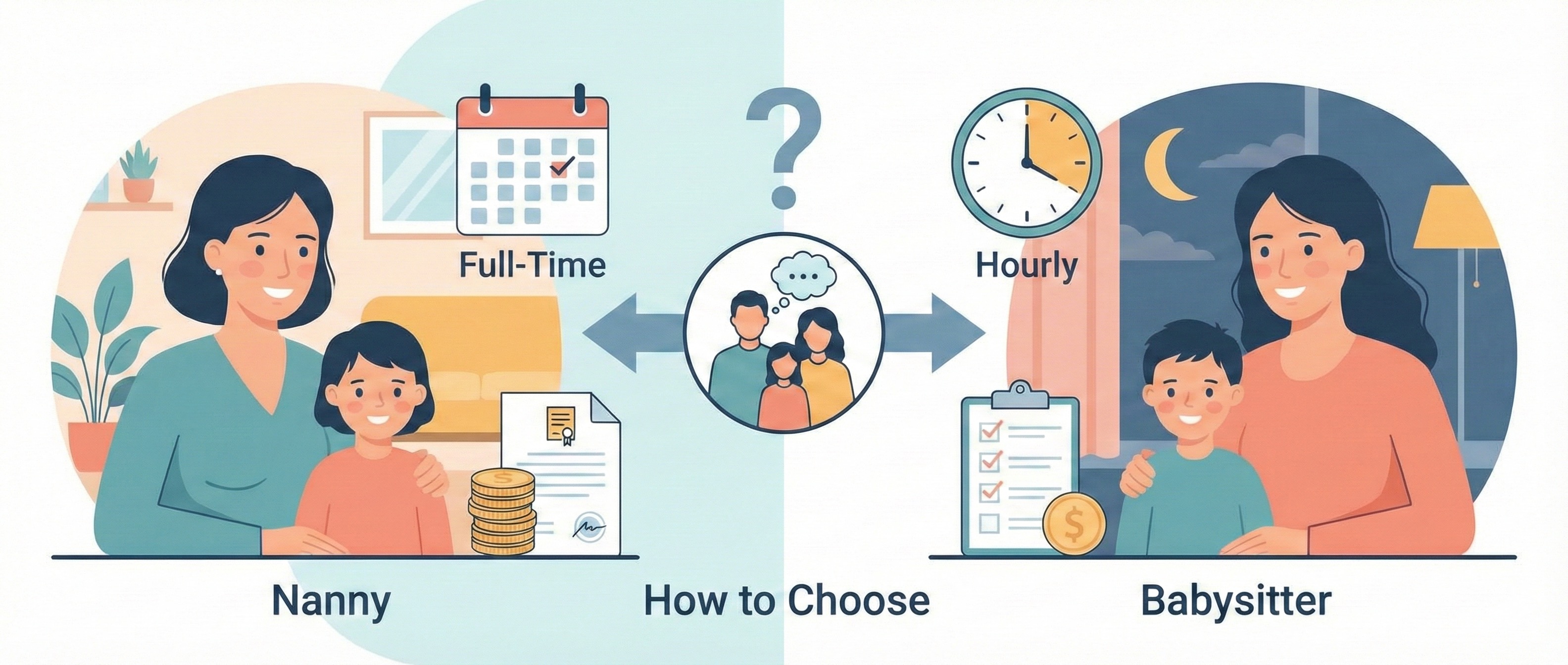
If you have ever used the words "babysitter" and "nanny" interchangeably, you are not alone. Most parents do. In everyday conversation, both terms describe someone who watches your kids while you are not there, and nobody is going to correct you at a dinner party for mixing them up.
But when you are actually hiring someone to care for your children, the distinction matters. The difference between a nanny and a babysitter affects how much you pay, what you can expect, how you structure the relationship legally, and ultimately which option is the right fit for your family's needs.
This guide breaks down the nanny vs babysitter comparison across every dimension that matters: responsibilities, cost, schedule, legal requirements, and the practical scenarios where one clearly makes more sense than the other.
A nanny is a regular, ongoing childcare provider who works a consistent weekly schedule and is your household employee. A babysitter is an on-demand caregiver hired for occasional or as-needed care. The core difference is commitment level: nannies provide structured, long-term care; babysitters provide flexible, short-term coverage.
What Is a Babysitter?
A babysitter is someone you call when you need childcare for a specific, usually short-term occasion. Date night. A Saturday afternoon errand run. A weekday when your regular childcare falls through. The relationship is transactional and event-based: you need coverage for a defined window of time, and the babysitter provides it.
Typical babysitter characteristics include:
- Occasional, as-needed schedule: No fixed weekly hours. You book them when you need them.
- Shorter engagements: Typically 3 to 6 hours per session, though full-day and overnight bookings happen too.
- Supervision-focused duties: Keeping children safe, fed, and entertained. Following the routines you set.
- Multiple clients: Most babysitters work for several families, not exclusively for one.
- Minimal employer obligations: In most cases, no payroll, benefits, or employment contract required (though there are exceptions based on earnings thresholds).
- Variable experience levels: Ranges from college students earning extra income to career childcare professionals who prefer flexible scheduling.
Babysitters are the right choice when your childcare needs are irregular, unpredictable, or supplemental to another primary arrangement. For a detailed look at what babysitters charge in 2026, see our babysitter cost and pricing guide.
What Is a Nanny?
A nanny is a dedicated childcare professional who works for your family on a regular, ongoing basis. The relationship is deeper, more structured, and more like a traditional employment arrangement. A nanny becomes part of your household's rhythm in a way a babysitter typically does not.
Typical nanny characteristics include:
- Consistent weekly schedule: Usually 3 to 5 days per week, often 8 to 10 hours per day.
- Long-term commitment: Nanny positions are typically committed for at least a year, often much longer.
- Broad responsibilities: Beyond supervision, nannies handle meal preparation, school transportation, homework help, organizing activities, light housekeeping related to the children, and supporting developmental milestones.
- Exclusive to one family: A nanny's primary professional commitment is to your household (nanny-share arrangements being the exception).
- Household employee status: Nannies are legally employees, which means payroll taxes, potential benefits, and a formal employment relationship.
- Professional-grade experience: Most nannies have years of childcare experience, relevant certifications, and strong professional references.
To understand the full spectrum of nanny arrangements, from part-time to live-in to specialized roles, see our complete guide to nanny types.
5 Key Differences Between a Nanny and a Babysitter
Here are the five fundamental differences that separate a nanny from a babysitter, organized for quick reference:
- Schedule and commitment: Nannies work a fixed weekly schedule (typically 25 to 50+ hours per week) under a long-term arrangement. Babysitters are booked on-demand for individual sessions with no ongoing obligation from either party.
- Scope of responsibilities: Nannies manage the full arc of a child's day, including meals, transportation, activities, development, and child-related housekeeping. Babysitters focus on safe supervision during a defined period.
- Relationship depth: Nannies develop deep, ongoing relationships with children and become attuned to their personalities, developmental stages, and routines. Babysitters provide competent, caring supervision without the same depth of integration.
- Employment classification: Nannies are household employees with associated tax, payroll, and legal obligations. Babysitters are typically independent workers unless they earn above the annual household employee threshold ($3,000 in 2026).
- Cost structure: Nannies represent a significant annual expense ($35,000 to $75,000+ including taxes and benefits). Babysitters are a pay-per-use expense ($25 to $35 per hour) with no overhead.
Nanny vs Babysitter: Side-by-Side Comparison
| Factor | Nanny | Babysitter |
|---|---|---|
| Schedule | Fixed weekly (25 - 50+ hrs/wk) | On-demand, as-needed |
| Typical Session | Full days, 3 - 5 days/week | 3 - 6 hours per booking |
| Commitment | 1+ year standard | None; per-occasion |
| Duties | Full childcare + child-related housekeeping | Supervision, feeding, bedtime routine |
| Relationship | Deep, ongoing, developmental | Friendly, professional, session-based |
| Hourly Rate (2026) | $20 - $35/hr | $25 - $35/hr |
| Annual Cost | $35,000 - $75,000+ | Varies by usage (often $2,000 - $8,000/yr) |
| Taxes Required | Yes (household employee) | Only if paid $3,000+/year |
| Contract | Strongly recommended | Optional but advisable |
| Benefits | PTO, sick days, holidays typical | Not expected |
| Background Check | Essential | Essential |
Nanny vs Babysitter Cost Comparison
Cost is often the deciding factor. Here is a realistic breakdown of what each option costs in 2026 across common scenarios.
| Scenario | Babysitter Cost | Nanny Cost |
|---|---|---|
| Date night (4 hours, 2x/month) | $200 - $280/mo | N/A (overkill) |
| One full day per week (8 hrs) | $800 - $1,120/mo | $640 - $1,120/mo |
| Three days per week (24 hrs) | $2,400 - $3,360/mo | $1,920 - $3,360/mo |
| Full-time (40 - 50 hrs/wk) | Not practical | $3,200 - $5,800/mo |
| Overnight (12 hrs, one-time) | $200 - $350 flat | Included in salary |
These figures represent national averages. Rates in high-cost cities like New York, San Francisco, and Los Angeles run 20% to 40% higher. For detailed city-level nanny pricing, see our national nanny cost guide, and for babysitter-specific rates by city, see our babysitter cost guide.
See what a coordinated search looks like. The research is the easy part. In two minutes, watch how a Beverly coordinator runs the rest — agencies, screening, and contracts — so you don't have to.
Watch: Meet Beverly · 2 min →Which One Do You Need? A Decision Framework
Choosing between a nanny and a babysitter is less about which is "better" and more about which matches your family's actual circumstances. Here is a framework based on common scenarios.
You Probably Need a Nanny If:
- You need care 3 or more days per week. At this frequency, the consistency, depth of relationship, and employer structure of a nanny arrangement becomes clearly worthwhile.
- Both parents work full-time. You need someone who is reliably available on a set schedule, week after week, without the friction of constant rebooking.
- Your children are infants or toddlers. Younger children benefit enormously from a consistent caregiver who understands their routines, temperament, and developmental trajectory.
- You need transportation. School pickups, activity drop-offs, and playdates require a dedicated, reliable driver who knows your children's schedules.
- You want developmental engagement. A nanny who is present daily can actively support language development, socialization, motor skills, and age-appropriate learning in ways that occasional caregivers cannot.
You Probably Need a Babysitter If:
- You need care once or twice a week at most. Hiring a nanny for occasional coverage is like leasing a car to drive once a week. The economics do not work.
- Your primary need is date nights or errand coverage. A few hours of evening or weekend supervision is the textbook babysitter use case.
- You have a primary childcare arrangement but need backup. If your children attend daycare or school and you just need someone to fill occasional gaps, a babysitter is the right tool.
- Your children are school-age and relatively independent. Older children who need light supervision rather than intensive care are well-served by a competent babysitter.
- You want flexibility without commitment. If your schedule changes frequently and you cannot guarantee consistent hours, a babysitter arrangement avoids the obligation of a standing employment relationship.
It Could Go Either Way If:
- You need care 2 to 3 days per week. This middle ground is where many families struggle. A part-time nanny (with a contract and clear expectations) works well here, but so does a reliable babysitter who commits to a semi-regular schedule.
- You work from home and need partial coverage. Some families hire a babysitter for regular 4 to 5 hour blocks while they work from home. Others prefer the structure of a part-time nanny. Both can work.
- You are in a transitional period. Moving, changing jobs, or adjusting to a new family structure often creates temporary childcare needs. A babysitter provides bridge coverage until you determine your long-term arrangement.
Legal and Tax Differences: Nanny vs Babysitter
This is where the nanny vs babysitter distinction has the most concrete legal implications. Understanding these differences can save you from expensive mistakes.
When a Babysitter Is Just a Babysitter (Legally)
If you hire someone for occasional babysitting and pay them less than $3,000 in a calendar year (the 2026 threshold), your tax obligations are minimal. You do not need to withhold Social Security or Medicare taxes, issue a W-2, or set up a payroll system. The babysitter reports their own income on their personal tax return.
This applies to the classic babysitter scenario: a few hours here and there, no fixed schedule, total annual payments well under the threshold.
When a Nanny Is a Household Employee (Always)
A nanny working a regular schedule will almost always exceed the $3,000 threshold within the first month or two. At that point, you have clear legal obligations:
- Payroll taxes: You must withhold the employee's share of Social Security and Medicare taxes (7.65%) and pay the employer's matching share (7.65%). That is 15.3% of gross wages total.
- Federal and state unemployment taxes: FUTA (federal) and state unemployment insurance contributions apply.
- Workers' compensation: Required in most states for household employees.
- W-2 filing: You must issue a W-2 to your nanny by January 31 each year.
- Schedule H: You report household employment taxes on Schedule H of your personal tax return.
For a complete walkthrough of nanny tax obligations, including state-specific rules and common mistakes to avoid, see our nanny tax guide.
The Gray Zone: When Babysitters Become Employees
Here is where many families get tripped up. If your "babysitter" works every Tuesday and Thursday, earns $3,000 or more per year, and follows a schedule you set, the IRS considers them a household employee regardless of what you call them. The label does not matter; the working relationship does.
Signs your babysitter may actually be a household employee:
- They work on a regular, recurring schedule you set
- Annual payments exceed $3,000
- You control when, where, and how the work is performed
- They work primarily for your family
If two or more of these apply, consult a tax professional or use a household payroll service. The penalties for misclassifying a household employee are significantly more expensive than simply setting up payroll correctly from the start.
Contracts: Do You Need One?
For nannies, the answer is an unequivocal yes. A written nanny contract protects both parties and prevents the misunderstandings that damage otherwise good working relationships. Your contract should cover compensation, schedule, duties, paid time off, termination terms, and house rules.
For babysitters, a formal contract is less common but still smart if the arrangement is regular. At minimum, confirm in writing (even via text or email) the agreed-upon rate, expected hours, specific duties, and any house rules or restrictions. This takes five minutes and prevents the ambiguity that leads to awkward conversations later.
Background Checks Apply to Both
Whether you are hiring a nanny or a babysitter, a background check is not optional. Anyone who will be alone with your children should undergo at minimum a criminal history search, sex offender registry check, and identity verification.
For nannies, a comprehensive background check (including county-level criminal records, driving records, employment verification, and reference checks) is standard practice. For babysitters, a basic check covering criminal history and sex offender registries provides essential peace of mind at a lower cost.
For babysitter-specific screening advice and interview questions, see our guide to babysitter background checks and interview questions.
How Beverly Helps with Both Nannies and Babysitters
Beverly is built to support families hiring both nannies and babysitters. Whether you need a full-time nanny for your infant or a trusted babysitter for occasional weekends, Beverly coordinates the process so you spend less time searching and more time with your children.
- Background checks: Beverly facilitates comprehensive screening for both nanny and babysitter candidates, covering criminal history, sex offender registries, identity verification, and reference checks.
- Vetted candidates: Every caregiver on Beverly's platform has been screened and verified before they are matched with your family.
- Contract templates: Beverly provides customizable templates for both nanny employment agreements and babysitter booking confirmations.
- Payroll coordination: For nannies (and babysitters who cross the household employee threshold), Beverly connects you with payroll services that handle tax withholding, W-2 filing, and compliance.
- Local matching: Whether you are looking for a nanny in New York or a babysitter for Saturday nights in Austin, Beverly's matching system works across all major metro areas.
FAQ

See how Beverly actually works
Your family's hiring coordinator — one point of contact working top agencies, au pair programs, and your personal network, all at once.
Captions on — no sound needed.Even though we work to keep the information, stats, and details in this article accurate and up to date, please do your own financial and legal due diligence before acting on anything you read here, and reach out directly to the private companies and government agencies referenced for the most current details.