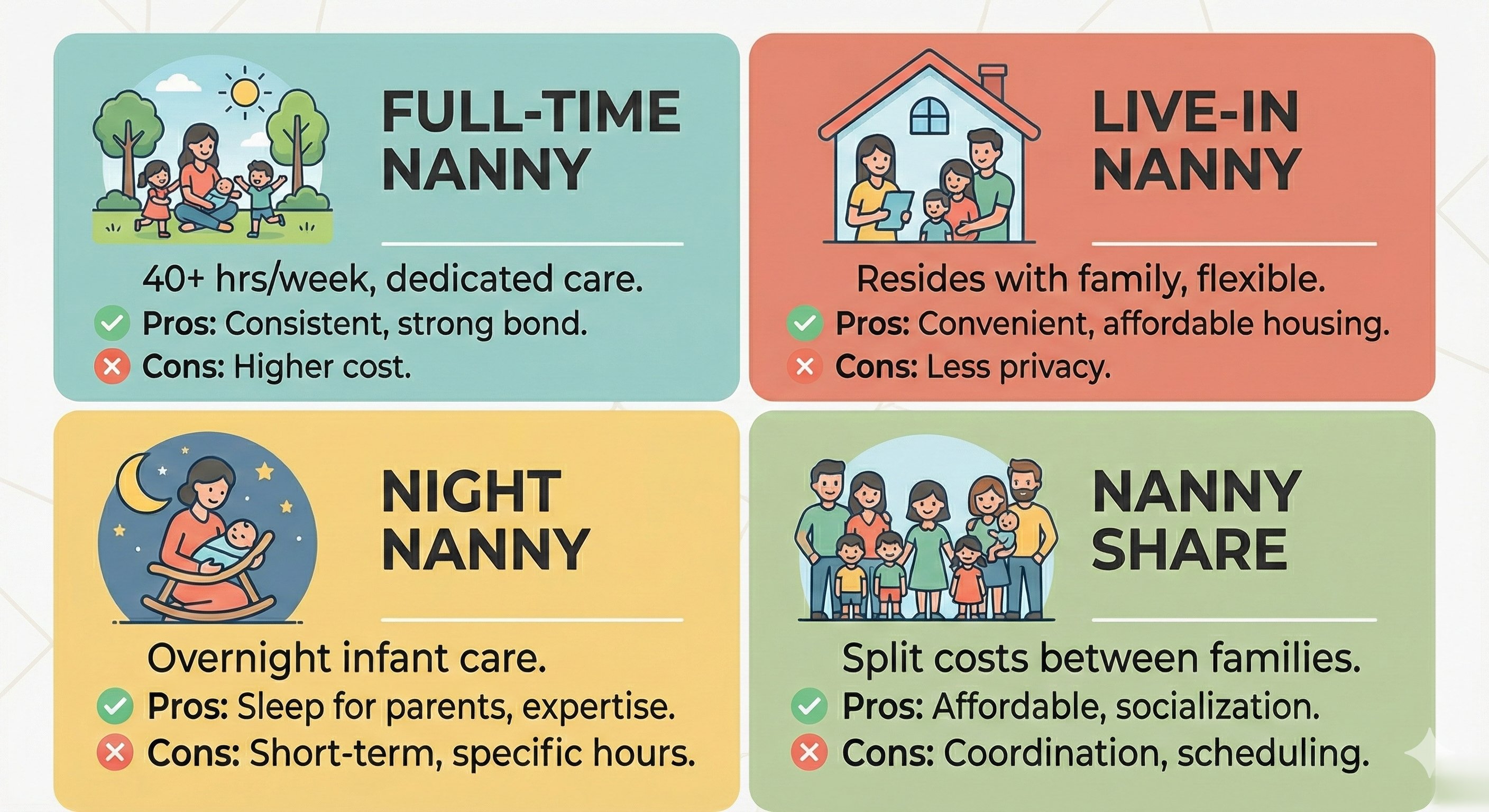
Hiring a nanny is one of the most consequential decisions a family makes in the first years of a child's life. But before you write a job description or browse candidate profiles, you need to answer a foundational question: what type of nanny does your family actually need?
The term "nanny" covers an enormous range of professional childcare roles. A live-in caregiver who becomes part of the household fabric is a fundamentally different arrangement from a night nanny who arrives at 10 p.m. and leaves at 6 a.m. A nanny share splits one caregiver across two families. A traveling nanny accompanies you on business trips and vacations. Each type comes with distinct scheduling expectations, compensation norms, duty scopes, and legal considerations.
Choosing the wrong type wastes time, strains budgets, and often leads to turnover within the first six months. Choosing the right type gives your family a sustainable care structure that adapts as your children grow. This guide walks through every major nanny type, compares them side by side, and helps you map your family's specific needs to the arrangement that will actually work.
There is no single "best" nanny type. The right choice depends on your weekly schedule, your children's ages and developmental needs, your budget, and your household structure. Many families combine types over time — starting with a newborn specialist, transitioning to full-time care, and eventually moving to part-time as kids enter school.
Quick Comparison: All Nanny Types at a Glance
Before we dive into the details of each nanny type, here is a high-level comparison to help you orient your search. Refer back to this table as you read through the deeper sections below.
| Nanny Type | Typical Hours | Cost Range | Best For |
|---|---|---|---|
| Full-Time Nanny | 40-55 hrs/week | $18-$30+/hr | Dual-income families; children under 5 |
| Part-Time Nanny | 15-34 hrs/week | $18-$28/hr | WFH parents; school-age children |
| Live-In Nanny | 45-60 hrs/week | $500-$1,200+/wk + room & board | Families with space; unpredictable hours |
| Night Nanny | 8-12 hrs overnight | $25-$40/hr | Newborn parents needing sleep |
| Nanny Share | 40-50 hrs/week | 60-70% of solo rate per family | Budget-conscious families; socialization |
| Newborn Care Specialist | Varies (24-hr shifts common) | $30-$50/hr | First 4-12 weeks postpartum |
| Traveling Nanny | Trip-based | Daily rate + travel costs | Family vacations; business travel |
| Temporary/On-Call Nanny | As needed | $20-$35/hr | Backup care; parental leave gaps |
1. Full-Time Nanny
A full-time nanny is the most common type of in-home childcare arrangement in the United States. Full-time typically means 40 to 55 hours per week, spread across four or five days. This is a W-2 employment relationship — the nanny is your household employee, and you are legally required to withhold payroll taxes and provide workers' compensation insurance in most states.
What a Full-Time Nanny Does
A full-time nanny's responsibilities extend well beyond basic supervision. For infants and toddlers, duties include diaper changes, bottle preparation and feeding, nap routines, tummy time, and early developmental play. For preschoolers and school-age children, the scope shifts to educational activities, homework help, school pickup and drop-off, managing playdates, and coordinating extracurricular schedules.
Most full-time nannies also handle child-related household tasks: children's laundry, tidying play areas, preparing meals and snacks for the kids, and maintaining the nursery. Some families negotiate additional duties — light household cleaning, grocery shopping, or pet care — but these should be explicitly outlined in a nanny contract and compensated accordingly.
Who Benefits Most from a Full-Time Nanny
Full-time nannies are the strongest fit for dual-income households where both parents work standard or extended business hours and have children under school age. They are also valuable for families with multiple children of different ages who need individualized attention that a daycare center may not provide. Consider this scenario: a marketing director and a software engineer in Austin, Texas both leave for work by 7:30 a.m. and return by 6 p.m. They have a two-year-old and a four-year-old. A full-time nanny arrives at 7 a.m., manages the morning routine, takes the four-year-old to preschool, provides one-on-one care for the toddler, handles pickup, and prepares dinner before the parents get home.
For a deeper breakdown of hours, duties, and compensation, see our complete full-time nanny guide. And for cost details, check our full-time nanny cost breakdown.
2. Part-Time Nanny
A part-time nanny works fewer than 35 hours per week — sometimes as few as 10 to 15 hours. This arrangement offers flexibility for families that do not need full-day coverage, whether because one parent works from home, children are in school for part of the day, or the family only needs afternoon and evening support.
Common Part-Time Schedules
Part-time nanny arrangements fall into several common patterns. Morning-only shifts (7 a.m. to noon) work for families where one parent takes over after lunch. After-school care (2 p.m. to 6 p.m.) is popular with families whose children attend school or daycare during the morning. Three-day-per-week schedules serve parents who work part-time themselves or job share with a partner. And split schedules — say, Monday/Wednesday/Friday from 8 a.m. to 3 p.m. — accommodate freelancers and entrepreneurs with variable workloads.
Compensation Considerations
Part-time nannies often command the same hourly rate as full-time nannies — sometimes even slightly higher — because they are forgoing the income stability and benefits that a full-time position provides. This means you are not necessarily saving 50% by hiring half the hours. The per-hour cost may be $18 to $28, and you should still offer guaranteed hours (a minimum number of hours paid each week regardless of whether you use them) to attract and retain quality candidates. See our nanny cost guide for more detail on budgeting for part-time care.
3. Live-In Nanny
A live-in nanny resides in the family home, typically in a private bedroom (and ideally a private bathroom). Live-in arrangements provide built-in flexibility — the nanny is available for early mornings, late evenings, and occasional weekend coverage without the delays of a commute.
How Live-In Arrangements Work
Despite living in the home, a live-in nanny is not on duty 24 hours a day. Federal and state labor laws still apply, and you must define working hours, rest periods, and days off. A common structure is 45 to 60 hours of on-duty time per week, with at least one to two full days off. When the nanny is off duty, they are free to use their private space without work interruptions.
Compensation for live-in nannies looks different from live-out arrangements. The weekly salary is typically lower than a live-out nanny's equivalent because room and board have tangible monetary value (often estimated at $200 to $400 per week for tax purposes, depending on your state). However, total compensation when you factor in housing, food, utilities, and possibly a vehicle can actually exceed what you'd pay a live-out nanny.
The Space and Boundary Requirements
Live-in arrangements demand physical space — a private room at minimum, though a separate suite or guest house dramatically improves the experience for both parties. Equally important are emotional boundaries. Families and nannies who thrive in live-in arrangements establish clear house rules about quiet hours, guest policies, kitchen access, and off-duty privacy. These should be documented in a comprehensive nanny contract. For more guidance, read our live-in nanny guide.
4. Night Nanny
A night nanny (sometimes called a night nurse, though most are not registered nurses) provides overnight infant care, typically from around 9 or 10 p.m. to 6 or 7 a.m. Their primary mission is to handle all nighttime feedings, diaper changes, soothing, and sleep-environment management so that exhausted parents can get uninterrupted rest.
Why Parents Hire Night Nannies
Sleep deprivation in the first months of a child's life is a documented risk factor for postpartum depression, impaired decision-making, and relationship strain. Night nannies address this directly. They are especially valuable for parents of multiples (twins or triplets), parents recovering from cesarean births, and single parents who have no partner to share overnight duties.
A typical engagement lasts three to twelve weeks, though some families keep a night nanny until the baby consistently sleeps through the night (usually around four to six months). Most night nannies also coach parents on sleep training techniques, feeding schedules, and healthy sleep hygiene practices for infants.
Night Nanny Costs
Night nannies charge between $25 and $40 per hour in most markets, with higher rates in cities like New York, San Francisco, and Los Angeles. A full night (10 hours) costs $250 to $400. Booking three to five nights per week is common for the first several weeks. For a detailed cost analysis, see our night nanny cost guide.
5. Nanny Share
A nanny share is an arrangement where two families hire one nanny to care for their children together, either in one family's home or on a rotating basis. Each family pays the nanny individually, and the total compensation the nanny receives is higher than a single-family rate — typically 1.3 to 1.4 times what one family would pay alone. This means each family pays roughly 60 to 70% of the solo nanny rate, saving thousands of dollars annually while the nanny earns more per hour than they would in a standard position.
How Nanny Shares Save Money
Consider this example: a full-time nanny in Denver earns $24 per hour from one family. In a nanny share arrangement, the same nanny might earn $34 per hour total — $17 per hour from each family. Family A saves $7 per hour (roughly $14,000 per year), Family B saves the same amount, and the nanny earns an additional $10 per hour. Everyone benefits.
But nanny shares require more coordination: aligning schedules, agreeing on parenting philosophies, establishing clear expectations about sick days, holidays, and backup care, and navigating the legal requirements of a nanny share. The families essentially enter a business partnership, and that partnership needs ground rules documented in writing.
Socialization Benefits
Beyond cost savings, nanny shares give children built-in peer interaction. For infants and toddlers who might otherwise spend their days in one-on-one care, having a same-age companion supports social development, sharing skills, and parallel play. This is a meaningful advantage for families who want the personalization of nanny care with the social benefits of a group setting.
6. Newborn Care Specialist
A newborn care specialist (NCS) is a highly trained professional who focuses exclusively on infant care during the first weeks to months of life. Unlike a general nanny, an NCS has specialized education in breastfeeding support, sleep conditioning, infant development, postpartum recovery support, and sometimes infant CPR and health monitoring.
Newborn Care Specialist vs. Night Nanny
While there is significant overlap between these two roles, the key difference is scope. A night nanny provides overnight care and sleep support. A newborn care specialist provides comprehensive newborn management — often on 24-hour shifts or extended daytime-plus-nighttime rotations — and focuses on establishing routines, optimizing feeding, and educating parents on all aspects of infant care. An NCS is also more likely to hold certifications from organizations like the Newborn Care Specialist Association (NCSA) or the International Nanny Association (INA).
For a detailed comparison, see our article on newborn care specialist vs. night nanny.
When to Hire a Newborn Care Specialist
Most families hire an NCS for the first four to twelve weeks postpartum. First-time parents benefit enormously from the education and confidence-building an NCS provides. Parents of multiples often hire an NCS for even longer, as the logistics of feeding and soothing two or three newborns simultaneously require expert-level skill. NCS rates are higher than standard nanny rates — typically $30 to $50 per hour — but the engagement is short-term, and many families describe it as the most valuable investment they made in their child's first year.
7. Traveling Nanny
A traveling nanny accompanies the family on trips — whether a week-long vacation, a business conference, or an extended relocation. Some families have a regular nanny who travels with them; others hire a dedicated traveling nanny specifically for trip-based childcare.
How Traveling Nanny Compensation Works
Traveling nanny pay is typically structured as a daily rate rather than an hourly rate, since the nanny is away from home and available for extended hours. Daily rates range from $200 to $500 or more, depending on the destination, the number of children, and the nanny's experience. In addition to the daily rate, the family covers all travel expenses: airfare, accommodation (a private room — never a shared room), meals, and any activity costs.
Hours during travel are often longer and less predictable than a normal workweek, so it is critical to discuss on-duty versus off-duty expectations before the trip. Will the nanny have evenings free while parents handle bedtime? Or will the nanny be expected to provide evening care so parents can enjoy a dinner out? These details belong in a written travel agreement.
Hiring Specifically for Travel
Not every nanny wants to travel, and not every family wants their regular nanny on vacation with them. Agencies and platforms that specialize in traveling nannies can connect you with caregivers who thrive on the road — individuals who are flexible, experienced with different environments, and skilled at maintaining routines in unfamiliar settings.
See what a coordinated search looks like. The research is the easy part. In two minutes, watch how a Beverly coordinator runs the rest — agencies, screening, and contracts — so you don't have to.
Watch: Meet Beverly · 2 min →8. Temporary Nanny and On-Call Sitters
Temporary nannies and on-call sitters provide short-term childcare coverage — anywhere from a single evening to several weeks. This category includes backup care for when your regular nanny is sick or on vacation, bridge care during a nanny transition, coverage during parental leave when extra hands are needed, and date-night or event-based babysitting.
When Temporary Care Makes Sense
Temporary nannies fill gaps that every family encounters. Your full-time nanny takes a two-week vacation. Your newborn care specialist's contract ends, but your permanent nanny does not start for another month. You are between daycare and kindergarten enrollment. A grandparent who was helping out has to leave. These transitions are normal, and having a reliable temporary care option prevents scrambling.
On-call sitters serve a different but equally important function. They are the caregivers you call for date nights, work emergencies, or weekend events. Building a small roster of two to three trusted on-call sitters gives you flexibility without committing to regular hours.
Finding Reliable Temporary Caregivers
The challenge with temporary care is trust. You are bringing someone into your home who does not have the long-term relationship and familiarity of a permanent nanny. Agencies that specialize in temporary and backup care vet candidates extensively, run background checks, verify references, and often send the same caregiver repeatedly so your children develop familiarity. For more on sourcing temporary caregivers, see our guide on how to find a nanny.
How to Choose the Right Type of Nanny
Matching your family to the right nanny type requires an honest assessment of several factors. Here is a step-by-step framework:
Step 1: Map Your Weekly Schedule
Write down every hour of every weekday and note when you need childcare coverage. Include commute time, after-work obligations, and any regular evening or weekend commitments. This exercise reveals whether you need full-time, part-time, or split coverage — and whether your schedule is consistent enough for a permanent arrangement or variable enough to require on-call flexibility.
Step 2: Assess Your Children's Developmental Needs
A six-week-old infant requires a caregiver with completely different skills than a seven-year-old who needs homework help and transportation to soccer practice. If you have a newborn, consider starting with a newborn care specialist or night nanny before transitioning to ongoing care. If you have school-age children, a part-time nanny focused on after-school hours may be sufficient.
Step 3: Calculate Your Budget Realistically
Your nanny budget is not just the hourly rate. It includes employer payroll taxes (approximately 10% above gross pay), workers' compensation insurance, paid time off, holiday pay, and potentially health insurance contributions. A $25-per-hour full-time nanny costs closer to $60,000 to $70,000 annually when you factor in all employer obligations. Use our comprehensive nanny cost guide to build an accurate budget.
If that number exceeds your budget, a nanny share or part-time nanny can reduce costs significantly while still providing high-quality, individualized care.
Step 4: Evaluate Your Living Space
A live-in nanny requires a private room and ideally a private bathroom. If you have the space, a live-in arrangement can offer unmatched flexibility and sometimes lower weekly costs. If your home cannot comfortably accommodate another adult, a live-out arrangement is the clear choice.
Step 5: Consider Your Long-Term Childcare Arc
Children's needs change rapidly. The nanny arrangement that works perfectly for a six-month-old will not be the same arrangement you need when that child starts kindergarten. Think in phases: newborn specialist for weeks 1-12, full-time nanny from months 3 through age 5, then transition to part-time after-school care once school begins. Planning this arc in advance helps you hire with clear expectations and build relationships with nannies who can grow with your family.
Combining Nanny Types: A Layered Approach
Many families use multiple nanny types simultaneously or sequentially. Here are three common layered approaches:
The Newborn-to-Toddler Transition
- Weeks 1-8: Newborn care specialist provides 24-hour support, educates parents on feeding and sleep routines
- Weeks 8-12: Night nanny continues overnight care while parents handle daytime
- Month 3 onward: Full-time nanny begins, taking over daily care as parents return to work
The Budget-Conscious Dual Coverage
- Weekdays: Nanny share with another family provides full-time care at roughly 60% of the solo cost
- Evenings/weekends: On-call sitter from a vetted roster handles date nights and weekend events
The Flexible Work-From-Home Setup
- 3 days per week: Part-time nanny covers focused work days
- 2 days per week: Parent provides care during lighter work days
- As needed: Temporary nanny fills in during deadline crunches or meetings
The Hiring Process: From Type Selection to First Day
Once you have identified the right nanny type, the hiring process follows a consistent path regardless of the arrangement. For a comprehensive walkthrough, see our step-by-step guide to hiring a nanny. Here is a summary:
- Write a detailed job description that specifies the nanny type, hours, duties, compensation range, required experience, and any non-negotiables (CPR certification, driver's license, language skills).
- Source candidates through multiple channels — nanny agencies, community referrals, and local parent networks. Casting a wide net increases your chances of finding the right match.
- Screen and interview at least five to ten candidates. Ask scenario-based questions about how they have handled emergencies, developmental milestones, and discipline situations.
- Check references thoroughly. Speak with at least two previous employer families and ask specific questions about reliability, communication, and childcare quality.
- Run a background check. This is non-negotiable for anyone caring for your children in your home.
- Draft a nanny contract covering compensation, schedule, duties, PTO, termination terms, and house rules. A written agreement protects both parties. Use our nanny contract template as a starting point.
- Complete a trial period. One to two weeks of supervised care allows you to evaluate the nanny's fit with your children and household before committing to the full arrangement.
Legal and Tax Considerations by Nanny Type
Regardless of the type of nanny you hire, if you pay a household employee more than $3,000 per year (as of 2026), you are required to withhold and pay employment taxes. This includes Social Security and Medicare (FICA), federal and state unemployment taxes, and income tax withholding. Some states have additional obligations, such as disability insurance or paid family leave contributions.
Key variations by type:
- Full-time and part-time nannies: Standard W-2 employment. Quarterly tax filings, annual W-2 issuance.
- Live-in nannies: Room and board may count as taxable compensation depending on your state. Overtime rules often differ for live-in employees.
- Night nannies and NCS: Short-term engagements may still trigger tax obligations if total compensation exceeds the threshold.
- Nanny shares: Each family is a separate employer. Both families file taxes independently for their portion of the nanny's wages. See our nanny share legal guide for details.
- Temporary nannies through agencies: The agency may serve as the employer of record, handling taxes on your behalf. Confirm this arrangement in writing.
Never pay a nanny "under the table." It exposes you to IRS penalties, denies your nanny access to unemployment benefits and Social Security credits, and invalidates your ability to claim the Child and Dependent Care Tax Credit — which can save you up to $3,000 per year for two or more children under the 2026 rules.
Red Flags When Choosing a Nanny Type
As you evaluate different nanny arrangements, watch for these common mistakes:
- Overestimating your need for hours. Hiring a full-time nanny when you really need 25 hours per week leads to inflated costs and a nanny who feels underutilized.
- Underestimating travel nanny expectations. Assuming your regular nanny will happily travel without discussing compensation, hours, and private accommodation creates resentment.
- Choosing live-in without private space. Asking a nanny to share a bathroom with the children or sleep in a common area guarantees burnout and turnover.
- Entering a nanny share without written agreements. Verbal agreements between families break down quickly when sick days, holidays, and scheduling conflicts arise.
- Skipping the trial period. No interview, no matter how thorough, reveals how a nanny interacts with your children in real-time over multiple days.
How Beverly Helps You Find the Right Nanny Type
Searching for a nanny across multiple platforms, agencies, and referral networks is time-consuming and fragmented. Beverly consolidates the entire search. You tell us what type of nanny you need — full-time, part-time, live-in, night nanny, nanny share, or anything in between — and Beverly coordinates your search across every relevant source. We handle candidate sourcing, initial screening, background checks, and scheduling so you can focus on the interviews and decisions that matter.
Whether you are a first-time parent navigating newborn care or a family of five looking for a full-time nanny who can manage school pickups, meal prep, and extracurricular logistics, Beverly matches you with candidates whose experience, certifications, and working style align with your specific arrangement.
When a Babysitter Is the Right Choice
While this guide focuses on the many types of nannies, it is worth addressing the elephant in the room: sometimes a nanny is not what your family needs at all. A babysitter may be the better fit depending on your schedule, budget, and the kind of care your children require. Understanding when to hire a babysitter versus a nanny prevents you from overcommitting financially or underserving your family's actual needs.
A babysitter makes sense when: you need fewer than 15 hours of care per week, your needs are occasional rather than on a set schedule (date nights, weekend events, school breaks), you already have a primary childcare arrangement and need supplemental coverage, or you are testing the waters before committing to a full nanny hire. Babysitters provide flexibility that nannies cannot. You book them when you need them, pay only for the hours used, and avoid the employment taxes, benefits, and guaranteed hours that come with a formal nanny arrangement.
Typical babysitter arrangements include weekly date-night coverage (3-5 hours), after-school care two to three days per week, weekend daytime care during errands or activities, and backup coverage when your nanny is on vacation or sick leave. Many families maintain a roster of two to three trusted babysitters to ensure availability. Unlike nannies, babysitters generally do not handle household duties, meal planning, or developmental programming. Their role is focused on safe, attentive supervision for a defined period.
From a cost perspective, babysitters charge $20-$35 per hour depending on your city, compared to the $18-$35+ hourly rate (plus 15-25% in employer overhead) for a nanny. A family using a babysitter for 8 hours per week at $28/hr spends roughly $11,650 per year, versus $50,000-$75,000 for a full-time nanny. The savings are dramatic for families whose care needs genuinely are occasional.
For a detailed cost breakdown, see our complete babysitter cost guide. For a thorough comparison of the two roles including scheduling, responsibilities, and relationship dynamics, read our guide on the key differences between nannies and babysitters.
Frequently Asked Questions

See how Beverly actually works
Your family's hiring coordinator — one point of contact working top agencies, au pair programs, and your personal network, all at once.
Captions on — no sound needed.Even though we work to keep the information, stats, and details in this article accurate and up to date, please do your own financial and legal due diligence before acting on anything you read here, and reach out directly to the private companies and government agencies referenced for the most current details.