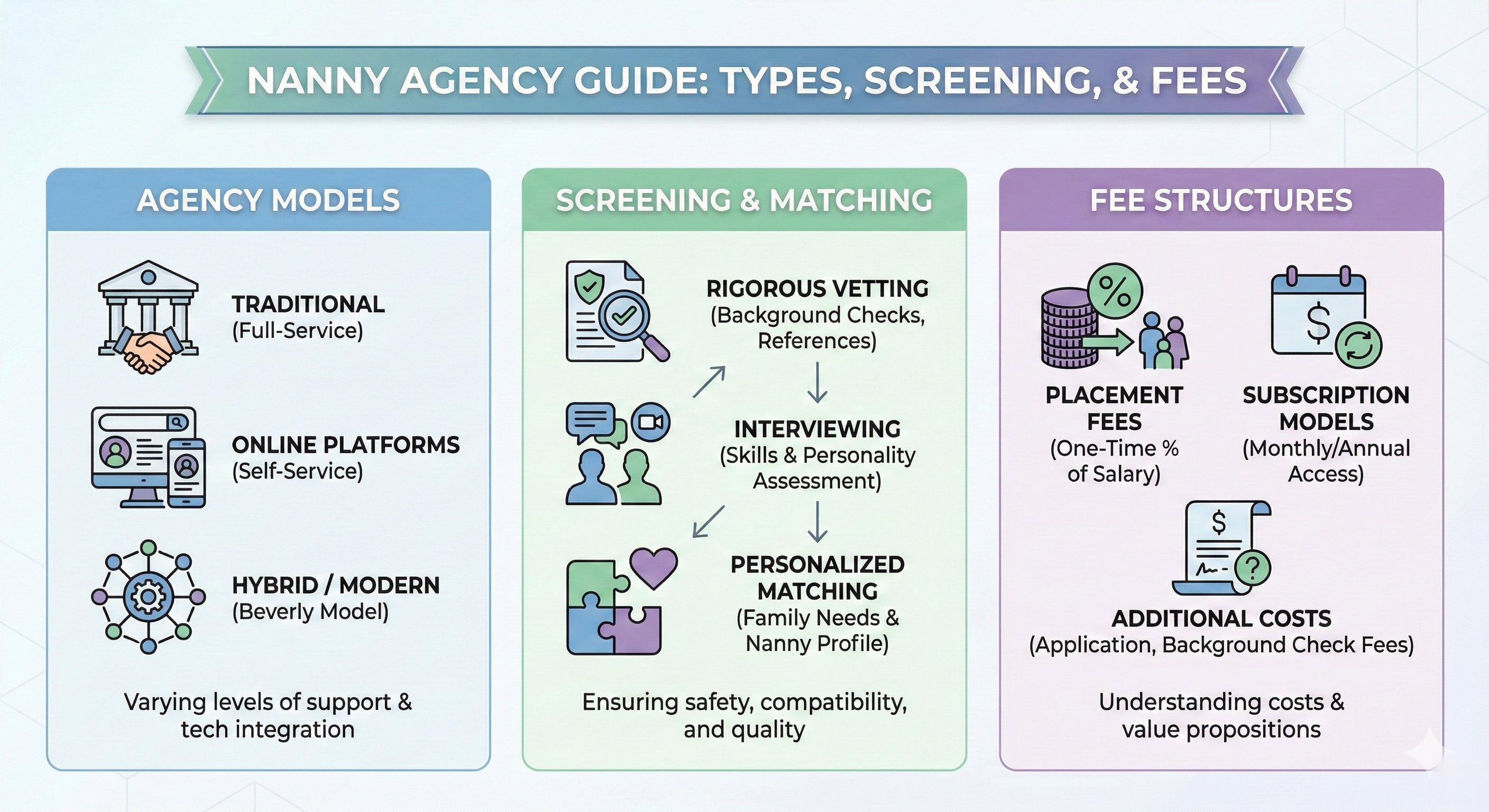
If you are searching for a nanny agency, you are probably looking for someone to take the most stressful parts of the hiring process off your plate: finding qualified candidates, verifying their backgrounds, and presenting you with vetted options so you can focus on choosing the right person for your family.
That is exactly what a good nanny agency does. But the agency landscape in 2026 is more fragmented than ever. There are boutique firms that maintain curated rosters of 50 candidates. There are national franchises with thousands of profiles in a database. There are online platforms that call themselves agencies but function more like job boards. And the fee structures range from $3,000 to $18,000 or more, with quality that does not always correlate with price.
This guide helps you understand how nanny agencies work, what they charge, what their screening actually includes, and how to evaluate whether a specific agency is worth your money. We will also cover when an agency makes sense, when it does not, and how Beverly's hiring coordinator model offers a different approach to the same problem.
The best nanny agency is the one that fits your specific market, budget, and timeline. Most agencies charge 15% to 20% of the nanny's first-year salary ($5,000 to $18,000), but fees alone do not determine quality. Screening rigor, candidate pool depth, and local market expertise matter more than brand recognition. For families who want to maximize their candidate pool, searching across multiple agencies and platforms simultaneously produces faster, better results than working with a single agency.
How Nanny Agencies Work
The traditional nanny agency model has remained largely consistent for decades, even as the broader childcare industry has evolved. Here is how it typically works:
- Intake: You contact the agency and complete a detailed questionnaire about your family's needs: schedule, number and ages of children, job requirements, compensation range, neighborhood, and any special requirements (bilingual, infant experience, special needs, etc.)
- Candidate matching: The agency searches its roster for candidates who match your criteria. Depending on the agency's size and your requirements, this might produce 3 to 8 candidates or as few as 1 to 2
- Presentation: The agency presents candidate profiles, typically including a resume, screening summary, and the agency's notes on fit. You review and select candidates to interview
- Interviews: You interview candidates, usually starting with a phone screen and progressing to an in-person or video meeting. Some agencies facilitate the scheduling; others leave this to you
- Selection and placement: You make an offer, the agency facilitates the transition, and you pay the placement fee. The replacement guarantee period begins
The entire process typically takes 2 to 5 weeks from intake to placement, though this varies significantly by market and how specific your requirements are. For the complete hiring framework beyond just the agency search, see our step-by-step nanny hiring guide.
Types of Nanny Agencies
Not all agencies are the same. Understanding the different models helps you choose the right type for your situation.
Boutique Agencies
Owner-operated firms that typically serve a single metro area or region. They maintain smaller candidate rosters (50 to 300 nannies) but offer highly personalized service. The owner often conducts intake meetings and stays involved throughout the process. Boutique agencies tend to have the deepest local knowledge and the most thorough screening, but their candidate pools are limited. If they do not have a match on their roster, they have fewer options to pull from. Placement fees range from $5,000 to $18,000 depending on the market.
Franchise and Multi-Office Agencies
These operate in multiple cities with standardized processes and centralized candidate databases. They offer consistency and scale. A franchise in Denver follows the same screening protocol as one in Boston. The trade-off is that local expertise and personal attention can vary by office. Placement fees typically range from $4,000 to $15,000.
National Full-Service Agencies
Large agencies that serve families nationwide, often specializing in placements for high-net-worth households, relocation situations, or families with complex needs (travel nannies, newborn specialists, nannies with advanced certifications). They maintain extensive databases and can recruit nationally for hard-to-fill positions. Placement fees range from $8,000 to $20,000 or more for specialized roles.
Online Platforms (Not Traditional Agencies)
Services like Care.com, UrbanSitter, and Sittercity are not agencies in the traditional sense. They are self-service platforms where you search profiles, contact candidates, and manage your own screening. Subscription fees run $30 to $40 per month, making them dramatically less expensive than agencies. The trade-off is that you do all the work: reviewing applications, conducting phone screens, running background checks, and checking references. These platforms work well for families who are comfortable managing the process and want to save on placement fees.
What Nanny Agencies Charge
Agency fee structures fall into two main categories:
Percentage-Based Fees
The most common structure. Agencies charge 15% to 20% of the nanny's estimated first-year gross salary. For a nanny earning $60,000, that is $9,000 to $12,000. For a nanny earning $80,000 in a premium market, that is $12,000 to $16,000. The percentage model means your fee scales with nanny compensation, so families in high-cost markets pay proportionally more.
Flat-Fee Structures
Some agencies charge a fixed placement fee regardless of the nanny's salary. Flat fees typically range from $3,000 to $18,000 depending on the market and service level. This model can be more cost-effective in premium markets where nanny salaries are high. It can also be more transparent, since you know the total cost upfront.
Additional Fees to Watch For
- Registration or intake fees: $0 to $500, charged upfront before any placement. Not all agencies charge this; many apply it toward the placement fee
- Background check fees: Usually included in the placement fee, but some agencies charge this separately ($75 to $200)
- Temporary or trial period fees: If you want a nanny on a trial basis before committing, some agencies charge a separate temporary placement fee
- Rush fees: Agencies may charge a premium for expedited searches, typically 10% to 25% above the standard placement fee
For a comprehensive breakdown of total nanny employment costs beyond just the agency fee, see our nanny cost guide.
Agency Screening Standards: What to Expect and What to Verify
Agency screening is one of the primary reasons families pay for placement services. But screening quality varies enormously. Here is what a thorough screening process should include, and what you should verify yourself regardless.
What Good Agencies Screen For
- In-person or video interview: The agency should personally interview every candidate, not just review a submitted application. This is non-negotiable
- Criminal background check: Multi-state criminal records search, federal database check, and sex offender registry search
- Reference verification: Direct phone calls to at least 2 to 3 previous employers, with documented notes. Written references alone are insufficient
- Identity and employment eligibility: Verification of legal right to work and identity documentation
- Driving record: If the role involves driving children, a motor vehicle records check is essential
- CPR and first aid certification: Verification of current certification, not just a self-reported claim
What You Should Still Verify Yourself
Even with a thorough agency screen, we recommend families independently verify:
- References: Call at least one reference yourself. Ask specific behavioral questions, not just general satisfaction. Our reference check guide provides the exact questions to ask
- Background check details: Ask the agency for the specific scope of their background check. Some agencies run minimal checks and call them comprehensive
- Skills assessment: If you need specific skills (infant care, special needs experience, bilingual ability), verify these through your own interview process. Agencies can filter for these but rarely conduct skills assessments themselves
- Trial period: No amount of screening replaces seeing a candidate work with your children. Always conduct a paid trial day before making a final commitment
See what a coordinated search looks like. The research is the easy part. In two minutes, watch how a Beverly coordinator runs the rest — agencies, screening, and contracts — so you don't have to.
Watch: Meet Beverly · 2 min →How to Evaluate and Choose an Agency
Here are the criteria that actually matter when selecting a nanny agency:
- Years in business: Agencies that have operated for 5 or more years have deeper candidate networks and more refined processes. Newer agencies can be excellent, but they carry more risk
- Specialization: An agency focused on nanny placement delivers better results than a general staffing firm that also places nannies. Specialization means deeper expertise in screening, market knowledge, and candidate relationships
- Screening methodology: Ask the agency to walk you through their screening process step by step. If they cannot provide specific details, that is a warning sign
- Candidate pool size and quality: Ask how many active candidates are on their roster and how many placements they make per month. An agency that places 5 to 10 nannies per month in your metro has a healthy, active pool
- Replacement guarantee: 60 days is the minimum acceptable guarantee period. 90 days is better. Get the terms in writing, including what voids the guarantee
- Client references: Ask for contact information from 3 families who were placed within the last 6 months. A reputable agency will provide this without hesitation
- Local market knowledge: The agency should understand neighborhood dynamics, commute patterns, and cost-of-living factors in your area. Test this by asking about typical rates in your specific neighborhood
- Communication responsiveness: How quickly does the agency respond to your initial inquiry? First-contact response time is a reliable indicator of how they will communicate throughout the process
- Employment law guidance: The best agencies provide basic guidance on nanny tax obligations, paid leave requirements, and employment agreements. They should at minimum refer you to appropriate resources
- Post-placement support: Does the agency offer any support after the placement is made? Some provide mediation services, check-in calls, or guidance if issues arise beyond the guarantee period
Nanny Agency Costs by City
Nanny rates and agency fees vary significantly by market. Here is a 2026 comparison across 12 major metros:
| City | Avg Hourly Rate | Typical Agency Fee |
|---|---|---|
| New York City | $28 - $45 | $8,000 - $18,000 |
| Los Angeles | $25 - $42 | $6,000 - $15,000 |
| San Francisco | $30 - $50 | $9,000 - $20,000 |
| Chicago | $22 - $38 | $5,000 - $13,000 |
| Miami | $22 - $38 | $4,500 - $12,000 |
| Austin | $20 - $35 | $4,000 - $10,000 |
| Dallas | $20 - $35 | $4,000 - $10,000 |
| Atlanta | $20 - $35 | $4,000 - $10,000 |
| Phoenix | $18 - $32 | $3,500 - $9,000 |
| Washington DC | $25 - $42 | $6,000 - $15,000 |
| Seattle | $24 - $42 | $5,500 - $14,000 |
| San Diego | $22 - $38 | $4,500 - $11,000 |
These ranges reflect full-time, experienced nanny placements. Rates for part-time, entry-level, or specialized (newborn care, special needs) positions may fall outside these ranges. For city-specific deep dives, see our guides for New York, Los Angeles, Phoenix, Washington DC, Seattle, and San Diego.
When an Agency Makes Sense (And When It Does Not)
An Agency Is Worth Considering When:
- Your time is extremely valuable: If your professional hourly rate exceeds $200, the 15 to 30 hours an agency saves you in screening time can justify the placement fee on a pure cost basis
- You need a specialized candidate: Newborn care specialists, nannies with special needs experience, bilingual candidates, or live-in nannies are often easier to source through agencies with established networks in those niches
- You are new to hiring household employees: Agencies provide structure and guidance on compensation benchmarking, employment agreements, tax obligations, and relationship management that first-time employers benefit from
- You need someone quickly: Top agencies can present qualified candidates within 5 to 10 business days. An independent search typically takes 3 to 6 weeks
- You want a replacement guarantee: If the placement does not work out within 60 to 90 days, agencies provide a replacement at no additional cost. Independent hires offer no safety net
An Agency May Not Be Necessary When:
- You have a strong referral network: Personal recommendations from trusted friends or family members often produce better matches than agency screening, and they cost nothing
- You are budget-constrained: The $5,000 to $18,000 agency fee is significant. If your budget is tight, the $100 to $400 cost of an independent search through platforms and referrals may make more sense
- You have hiring experience: If you have managed hiring processes in your professional life, screening nanny candidates yourself is entirely manageable with the right framework. See our interview questions guide
- Your requirements are straightforward: If you need a reliable, experienced nanny for a standard full-time schedule with no specialized requirements, the broader candidate pool on online platforms may serve you better than a curated agency roster
For a more detailed comparison of these approaches, see our agency vs. private hire guide.
Beverly vs. Traditional Nanny Agencies
Beverly is not a nanny agency. Beverly is a hiring coordinator that searches across agencies and referral networks simultaneously to find your nanny faster. The distinction matters because it changes the fundamental search dynamic.
A traditional agency shows you candidates from its own roster. If none of those candidates are the right fit, you either wait for new candidates to join the roster or start over with a different agency. Beverly eliminates this limitation by searching every available channel at the same time.
| Factor | Traditional Agency | Beverly |
|---|---|---|
| Candidate Sources | Agency's own roster only | Multiple agencies + platforms + referrals |
| Search Scope | Limited to one network | Entire local market |
| Screening Consistency | Varies by agency | Standardized across all sources |
| Candidate Presentation | Only agency-rostered candidates | Best candidates regardless of source |
| Fee Structure | 15-20% of salary or $3K-$18K flat | Transparent coordination fee |
| Typical Timeline | 2 - 5 weeks | Faster with parallel search |
| Replacement Support | 60 - 90 day guarantee | Ongoing support beyond placement |
| Employment Law Guidance | Varies widely | Built into coordination process |
| Post-Placement Support | Ends after guarantee period | Continued relationship |
The practical result is that Beverly families see more qualified candidates, find them faster, and get consistent screening regardless of where the candidate originates. You are not betting on one agency's roster. You are covering the entire market.
FAQ

See how Beverly actually works
Your family's hiring coordinator — one point of contact working top agencies, au pair programs, and your personal network, all at once.
Captions on — no sound needed.Even though we work to keep the information, stats, and details in this article accurate and up to date, please do your own financial and legal due diligence before acting on anything you read here, and reach out directly to the private companies and government agencies referenced for the most current details.