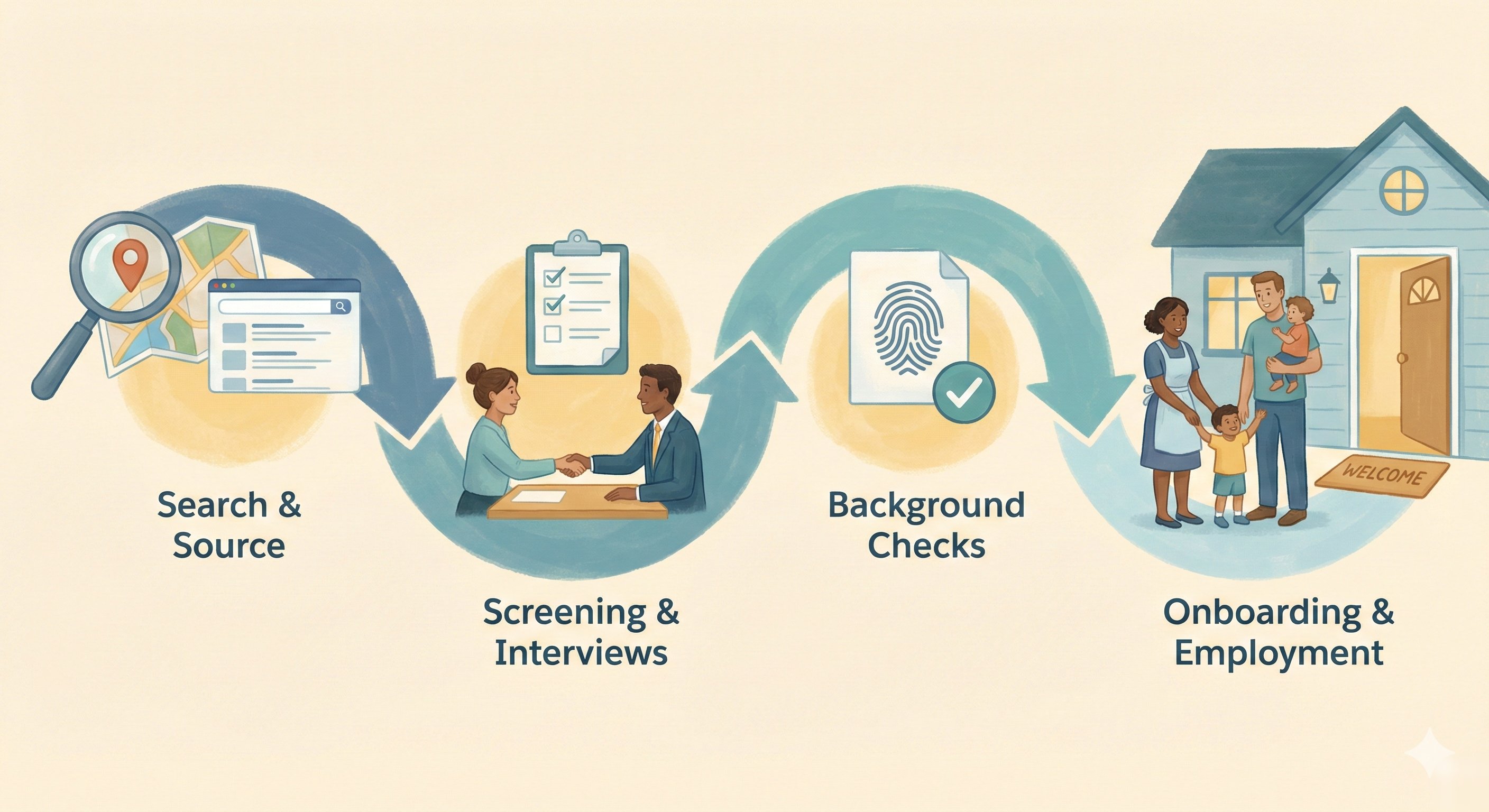
Hiring a nanny is one of the most consequential decisions you will make as a parent. You are choosing the person who will shape your child's daily experience, respond to emergencies in your absence, and become a fixture of your household for months or years. The stakes are high, and the process is surprisingly opaque. There is no centralized marketplace, no standardized credentialing, and very little transparency around pricing or quality.
This guide walks you through every phase of the nanny hiring process, from clarifying what your family actually needs to onboarding your new hire on day one. It is designed for busy professionals who cannot afford to spend weeks on a disorganized search. Whether you are a dual-income couple expecting your first child or a single parent returning to work after a career break, the framework here will help you hire with confidence.
The most successful nanny hires share one trait: the family defined their non-negotiables before they ever posted a listing. Clarity at the start eliminates most of the friction that derails searches.
Step 1: Define Your Family's Needs
Before you write a single job posting or contact an agency, you need honest answers to several foundational questions. Skipping this step is the number one reason families end up restarting their search after three or four weeks of wasted effort.
Schedule and Hours
Map out your actual weekly schedule, not the idealized version. If you are a litigator whose trials regularly run past 6 PM, your nanny needs to be available until 7:30 or 8:00. If your partner travels every other week, those solo weeks require different coverage. Write down your typical week, your busiest possible week, and the minimum coverage that keeps your household functional.
Most full-time nanny positions range from 40 to 50 hours per week. In high-demand markets like New York, San Francisco, and Washington, D.C., families increasingly structure schedules around 45-hour guaranteed weeks with overtime provisions for anything beyond. This structure gives both sides predictability.
Responsibilities Beyond Childcare
Decide upfront whether you expect your nanny to handle household tasks. The industry standard is that nannies manage child-related duties: meals for kids, children's laundry, tidying play areas, and organizing children's activities. Anything beyond that, such as family cooking, household errands, or pet care, is considered additional work and should be compensated accordingly.
Unclear expectations around household duties are the single most common source of nanny-family conflict in the first six months. For a deeper look at what different types of childcare providers handle, see our guide to nanny types.
Budget and Compensation
Your budget determines which candidates you can realistically attract. In 2026, full-time nanny compensation varies significantly by geography, experience level, and the number of children in your care.
| Market Tier | Hourly Range | Annual Gross (50 hrs/wk) | Total Cost w/ Taxes |
|---|---|---|---|
| Major Metro (NYC, SF, LA) | $28 - $45+ | $72,800 - $117,000+ | $80,000 - $131,000+ |
| Mid-Size City (Denver, Austin, Nashville) | $22 - $32 | $57,200 - $83,200 | $63,000 - $93,000 |
| Suburban / Lower-Cost Area | $18 - $25 | $46,800 - $65,000 | $52,000 - $73,000 |
These figures include the employer's share of FICA (Social Security and Medicare) taxes, which add approximately 7.65% to gross wages. Many families also budget for benefits such as paid time off, health insurance stipends, and guaranteed hours. For a full breakdown, see our nanny cost guide.
Non-Negotiables vs. Nice-to-Haves
Create two lists. Your non-negotiables might include: minimum three years of infant experience, current CPR certification, valid driver's license, English fluency, and willingness to work until 7 PM. Your nice-to-haves might include: bilingual Spanish/English, experience with twins, Montessori training, or willingness to travel with the family.
The more items on your non-negotiable list, the smaller your candidate pool. Families who list more than seven non-negotiables typically struggle to find any qualified candidates within four weeks. Ruthless prioritization here pays dividends later.
Step 2: Choose Your Search Channels
There are three primary ways to find a nanny: agencies and personal referrals. Each has distinct advantages, and the most effective approach is usually running two or three channels in parallel.
Nanny Agencies
Agencies pre-screen candidates, verify references, run background checks, and match families based on detailed profiles. The tradeoff is cost: placement fees typically run 15% to 20% of the nanny's first-year gross salary. For a nanny earning $70,000, that is $10,500 to $14,000.
Quality varies widely. Top-tier agencies in major metros maintain active rosters of 200 to 500 vetted candidates and guarantee replacements within 60 to 90 days. Budget agencies may simply forward resumes from public job boards with minimal vetting. For a detailed comparison, read our agency vs. private hire analysis.
Online Platforms
Sites like Care.com, Sittercity, and UrbanSitter offer the largest candidate pools. You can post a job and receive applications, or search profiles and reach out directly. Monthly subscriptions run $30 to $40. The downside is that all screening, vetting, and reference checking falls on you.
Personal Referrals
A recommendation from a trusted friend or colleague is often the strongest signal of quality. The challenge is scale: your personal network may not include anyone with a great nanny who is looking for a new position. Neighborhood parenting groups, school parent directories, and professional network listservs can widen the referral pool significantly.
Parallel Search Strategy
In our experience, families who search across two or more channels simultaneously hire meaningfully faster — often by a couple of weeks — than those who work one channel at a time. A typical parallel approach: register with one reputable agency, post on one to two online platforms, and send a note to your personal network all within the same week.
Step 3: Screen Candidates Efficiently
Once applications start arriving, you need a system to sort through them without burning 20 hours per week. A structured screening process saves time and surfaces the best candidates faster.
Resume and Application Review
Look for four things in the initial review: relevant experience with children your kids' ages, employment stability (frequent job changes without clear reasons are a yellow flag), geographic proximity or willingness to commute, and professional presentation. Discard candidates who do not meet your non-negotiables immediately.
Phone Screen (15-20 Minutes)
The phone screen is a gatekeeping step, not a deep interview. You are confirming logistics and basic fit. Cover these points:
- Availability and schedule alignment
- Compensation expectations (if misaligned, stop here)
- Driving status and transportation
- Reason for leaving their current or most recent position
- Comfort level with your specific childcare needs (infant care, special needs, multiple children)
If a candidate passes the phone screen, move them to the in-person interview stage. Most families phone screen 8 to 12 candidates to find 3 to 5 worth interviewing in depth.
Assessing Skills and Experience
Beyond conversation, consider practical evaluation. Our nanny skills assessment guide covers specific methods for testing a candidate's competence with age-appropriate activities, emergency response, and daily care routines. This is especially important for infant care positions, where experience claims are difficult to verify through conversation alone.
Step 4: Conduct In-Depth Interviews
The in-person (or video) interview is where you assess personality, communication style, childcare philosophy, and cultural fit. Plan for 60 to 90 minutes per candidate, and if possible, have your children present for at least part of the interview.
Structure Your Questions
Prepare questions across five categories: experience and qualifications, situational judgment, childcare philosophy, logistics and boundaries, and personality fit. Our comprehensive list of nanny interview questions provides 50+ questions organized by category with guidance on what strong answers look like.
Observe Interactions with Your Children
If your children are present, watch how the candidate engages. Do they get down to the child's level? Do they initiate interaction naturally or wait for direction? Do they seem comfortable with the age group? A candidate who interviews brilliantly but ignores your toddler during the meeting is telling you something important.
Watch for Warning Signs
Certain patterns in interviews should raise concern: vague or inconsistent answers about past employment, reluctance to provide references, negative comments about previous families, rigidity around schedule or duties, or an inability to describe how they have handled specific childcare challenges. For a deeper analysis, see our guide to red flags in nanny interviews.
Cultural and Philosophical Alignment
This is the area most families underweight and later regret. Your nanny will make hundreds of micro-decisions daily about discipline, screen time, food, social interaction, and risk tolerance. If your philosophy diverges significantly from theirs on any of these topics, conflict is inevitable.
Ask specific scenario questions: "My 3-year-old refuses to eat lunch. What do you do?" or "Two children are fighting over a toy. Walk me through your response." The answers reveal operating philosophy more reliably than abstract questions about childcare beliefs.
Step 5: Check References Thoroughly
Reference checks are the single most underutilized tool in the nanny hiring process. In our experience, a surprising number of families either skip references entirely or conduct them as a superficial formality. This is a costly mistake.
Who to Contact
Request references from the candidate's two most recent families. If a candidate has been with their current family for five or more years, you may need to go back further. Always contact the references directly rather than relying on written letters, which can be fabricated.
What to Ask
Go beyond "Were you satisfied?" and ask specific, behavioral questions:
- What were the ages of your children during the nanny's employment?
- Can you describe a specific situation where the nanny handled a difficult moment well?
- Were there areas where you wished the nanny had performed differently?
- How did the nanny handle communication about your children's day?
- Why did the nanny leave your employment?
- Would you rehire this person without hesitation?
Our detailed nanny reference check guide provides a complete question framework and explains how to read between the lines of diplomatic answers.
Red Flags in References
Pay attention to what references do not say. Hesitation before answering, qualified praise ("She was great... when she was focused"), or inability to provide specific examples of the nanny's strengths are all signals worth noting. A reference who declines to answer whether they would rehire the nanny is giving you a clear answer.
Step 6: Run Background Checks
A thorough nanny background check is non-negotiable. This is someone who will be alone with your children, possibly in your home with access to personal information and valuables. Background checks are standard professional practice, and good candidates expect them.
What to Include
- Criminal history search covering every state and county where the candidate has lived
- National sex offender registry search
- Identity verification (Social Security number trace)
- Motor vehicle records if the nanny will drive your children
- Employment verification for the past 7 to 10 years
Optional but recommended: credit check (relevant if the nanny will have access to household finances or credit cards) and social media review. For information on legal requirements and state-specific regulations, see our guide to nanny background check laws.
Cost and Timeline
Professional background screening services charge $50 to $200 depending on the depth of the search. Basic criminal checks return within 24 to 48 hours. County-level searches and employment verification can take 5 to 10 business days. Budget two weeks for a comprehensive check.
Health and Drug Screening
Some families also require health checks and drug screening as part of the hiring process. A standard 10-panel drug test costs $30 to $60 at most occupational health clinics. TB testing is increasingly common, especially for families with infants or immunocompromised household members.
See what a coordinated search looks like. The research is the easy part. In two minutes, watch how a Beverly coordinator runs the rest — agencies, screening, and contracts — so you don't have to.
Watch: Meet Beverly · 2 min →Step 7: Make a Competitive Offer
Once your top candidate has cleared all screening, move quickly. In competitive markets, top nannies receive multiple offers, and a delay of even three to four days can cost you your preferred candidate.
Compensation Package
Your offer should include:
- Gross hourly or weekly rate (always discuss in gross, pre-tax terms)
- Guaranteed hours (typically 40-50 per week, paid regardless of whether the family needs coverage)
- Overtime rate (federally mandated at 1.5x for hours over 40 per week in most states)
- Paid time off (industry standard is 10 days vacation plus federal holidays plus 3-5 sick days)
- Health insurance stipend (increasingly expected; $200-$400/month is common)
- Annual review and raise structure (3-5% annual increases are standard for strong performers)
For detailed guidance on structuring your offer, see our guide to negotiating with a nanny and our tips for attracting top nanny talent.
The Nanny Contract
Every nanny arrangement should be documented in a written work agreement. Its real job is communication: it prevents misunderstandings before they start. A comprehensive nanny contract covers compensation, schedule, duties, house rules, termination provisions, and confidentiality expectations.
Trial Period
Even after thorough screening, a trial period of two to four weeks gives both sides an opportunity to assess fit in real working conditions. Structure the trial with specific evaluation criteria so the review conversation is objective rather than based on vague feelings.
Step 8: Onboard Your New Nanny
The first two weeks set the tone for the entire employment relationship. Families who invest time in structured nanny onboarding report significantly higher satisfaction at the six-month mark compared to those who take a "figure it out as you go" approach.
Week One: Foundation
- Home tour and safety walkthrough: Show every room, demonstrate alarm systems, locate fire extinguishers, identify potential hazards
- Emergency information: Provide a written emergency plan including pediatrician contact, nearest hospital, poison control, and at least two emergency contacts besides the parents
- Daily routine review: Walk through a typical day in detail, including nap schedules, feeding routines, screen time rules, and activity preferences
- House rules and expectations: Cover everything from phone use to visitor policies to kitchen access
- Communication setup: Establish your preferred check-in cadence, messaging platform, and daily log format
Week Two: Gradual Independence
During the second week, begin stepping back. Start with short absences (one to two hours) and gradually extend. This gives the nanny confidence and gives you data points on how they perform independently. Check in at the end of each day during this period to address questions and reinforce expectations.
The 30-Day Check-In
Schedule a formal conversation at the 30-day mark. Review what is working well, address any concerns from either side, and confirm that the arrangement is meeting expectations. This checkpoint is also the appropriate time to finalize the employment relationship if you started with a trial period.
Legal and Tax Obligations
When you hire a nanny, you become a household employer. This carries real legal and tax responsibilities that many families overlook or intentionally ignore. Paying a nanny "under the table" exposes you to penalties, back taxes, and potential legal liability if the nanny is injured on the job.
Key Employer Obligations
- Employment taxes: Withhold and remit Social Security and Medicare taxes (7.65% each for employer and employee); federal and state income tax withholding is optional for household employers — you withhold it only if you and your nanny agree to it
- Workers' compensation insurance: Required in most states for household employees
- Unemployment insurance: Federal (FUTA) and state unemployment taxes apply to household employers
- I-9 verification: You must verify your nanny's eligibility to work in the United States
- W-2 filing: Issue a W-2 to your nanny by January 31 each year
Poppins Payroll specializes in household employment and handles all withholding, filing, and compliance for $49 per month. The cost is trivial compared to the risk of IRS penalties. Beverly members who are new Poppins clients get a full year of Poppins Payroll included in their membership. Consider also reviewing nanny liability insurance options to protect your family from additional risk.
Common Mistakes and How to Avoid Them
Mistake 1: Rushing the Search
Families starting childcare in two weeks often grab the first acceptable candidate. In our experience, these rushed hires are far more likely to turn over within six months than hires made by families who allowed four to six weeks for the search. Start your search at least eight weeks before your start date.
Mistake 2: Prioritizing Cost Over Fit
Saving $3 per hour on a candidate who is mediocre costs far more than the savings when you factor in the disruption of rehiring six months later. Pay market rate or above for a candidate who genuinely excites you.
Mistake 3: Skipping the Contract
Verbal agreements breed misunderstandings. Even if you and your nanny have a wonderful rapport, put everything in writing. The contract protects both parties and provides a reference document when questions arise.
Mistake 4: No Structured Onboarding
Handing over the kids and heading to work on day one is not onboarding. A nanny who does not fully understand your expectations, house rules, and children's routines cannot perform at their best. Two days of structured overlap is the minimum investment.
Mistake 5: Ignoring Cultural Fit
A nanny can have impeccable credentials and still be wrong for your family. Differences in communication style, discipline philosophy, or energy level create daily friction that erodes the relationship. Trust your instincts during the interview process, especially when observing the candidate with your children.
Nanny Hiring Timeline: Week by Week
| Week | Activity | Expected Output |
|---|---|---|
| 1 | Define needs, budget, non-negotiables | Written job description and family profile |
| 2 | Activate search channels (agency, platforms, referrals) | Job posted, agency engaged, network notified |
| 3 | Review applications, conduct phone screens | 3-5 candidates advanced to in-person interviews |
| 4 | In-person interviews (60-90 min each) | 1-2 finalists identified |
| 5 | Reference checks and background screening | Verification complete on top candidate |
| 6 | Extend offer, negotiate terms, sign contract | Signed work agreement |
| 7-8 | Onboarding, training, trial period begins | Nanny integrated into household routine |
Certifications and Qualifications to Prioritize
Not all certifications carry equal weight. At minimum, your nanny should hold current CPR and First Aid certification from the American Red Cross or American Heart Association. These certifications require renewal every two years, so verify the expiration date.
Beyond the basics, nanny certifications worth noting include the INA (International Nanny Association) credential, Newborn Care Specialist certification for infant positions, and early childhood education degrees or certificates. While formal credentials matter, they should complement rather than substitute for verified hands-on experience.
Special Considerations for Live-In Arrangements
Hiring a live-in nanny adds layers of complexity around privacy, boundaries, and living arrangements. Compensation structures differ (room and board offset a portion of the cash wage), and the lines between work time and personal time require explicit definition. If you are considering a live-in arrangement, dedicated guidance on those unique dynamics will help you avoid the most common pitfalls.
FAQ

See how Beverly actually works
Your family's hiring coordinator — one point of contact working top agencies, au pair programs, and your personal network, all at once.
Captions on — no sound needed.Even though we work to keep the information, stats, and details in this article accurate and up to date, please do your own financial and legal due diligence before acting on anything you read here, and reach out directly to the private companies and government agencies referenced for the most current details.